Medievalist fantasy can expose the myth-making mechanisms of actual medieval political culture. The influence of medieval English history is unmistakable in George R. R. Martin’s world of A Song of Ice and Fire, as he does not hesitate to admit. One who is familiar with the histories of the Wars of the Roses, the Hundred Years’ War, or the Anarchy would not fail to notice the parallels. Yet claiming that these are only parallels or influences that Martin, as a medieval history enthusiast, implements for the sake of creating a good story would understate their significance.
Fans of the novels and the TV shows have long been trying to identify the resemblances of the characters to the historical figures that they might be based on. Rhaegar Targaryen, who dies at the Battle of the Trident in Robert’s Rebellion without inheriting the throne, is often claimed to be based on Edward the Black Prince by the fans. However, apart from being the prince who never became king, the resemblance is limited, and as the fans have been introduced to Baelor Targaryen in 2026’s A Knight of the Seven Kingdoms, it becomes clearer why Baelor is a better candidate to carry the torch of Edward the Black Prince.
Baelor, the Perfect Heir
Even though the characters became popular recently with the airing of the TV show, The Hedge Knight is a novella that was written by Martin in 1998. In the case of Baelor Targaryen in the novella, the readers witness a valiant and politically successful heir apparent who dies while fighting in a trial by combat to protect a hedge knight, arguing that the hedge knight protected the innocent as a true knight must. His brother, Maekar, highlights that people loved Baelor and expected his reign to be prosperous, and he and Dunk will be blamed whenever a mishap falls on the realm. Baelor’s characterisation signifies the expectation could be met by him; his memory of Ser Arlan of Pennytree when Dunk fails to find anyone who would vouch for him to participate in the jousts, his discontent towards his nephew’s non-chivalrous actions, and his willingness to act in Dunk’s interest all portray an heir that is politically and morally competent.
His competence is not limited to politics. He is known to be a valiant warrior, participating in the Blackfyre Rebellions and successfully repelling the rebels. Along with his brother Maekar, they defeated the armies of the rebels by trapping them in between their forces, earning the nicknames “the Anvil” and “the Hammer”. Hence, combined with his political feats, his brilliance in battle tactics made him appear both chivalrous and wise. He seems to make the perfect king that a medievalist would dream of.
The Black Prince: Glory and Governance
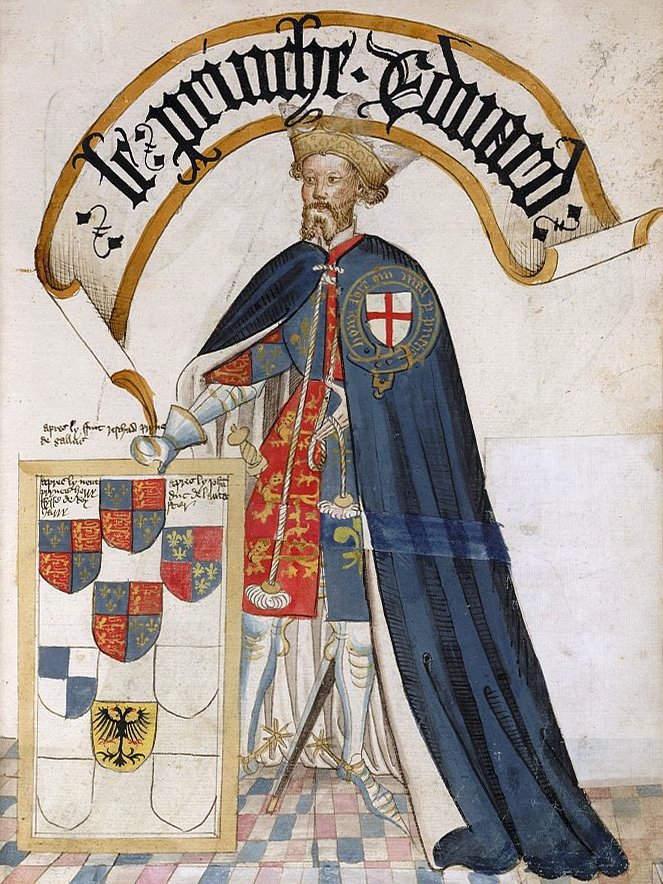
What does this image have to do with the Black Prince? His contemporaries, most famously Froissart, describe him as “the flower of chivalry”. His feats in the Hundred Years’ War earned him the reputation of a chivalrous prince. He famously commanded the English vanguard in the Battle of Crécy at the age of 16, after his father Edward III refused to send help and told his entourage to let the boy “win his spurs”. The Black Prince also captured King John II of France at the Battle of Poitiers despite being outnumbered. In his later campaigns, he also successfully restored Peter of Castile to the Castilian throne in the Battle of Najera. These feats have enabled chroniclers like Froissart to compliment his martial nobility and knightly virtue.
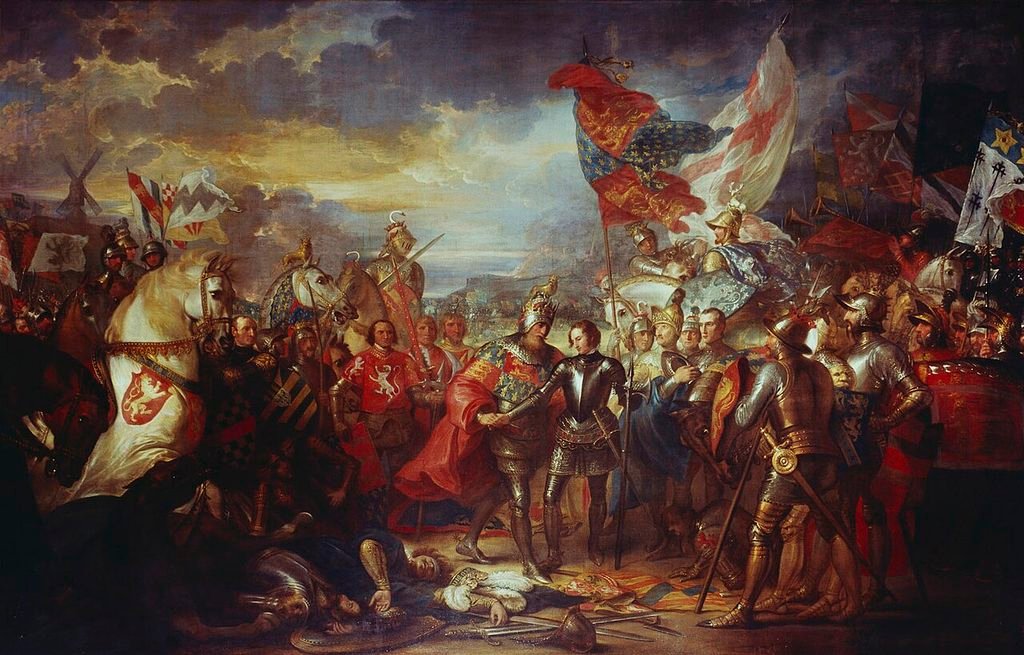
Baelor is addressed as the “soul of chivalry” by Dunk, who says Ser Arlan praised him often and referred to him as such, and the Black Prince’s image rests on the same kind of praise. The difference is that the Black Prince actually had to govern. In 1362, Edward III created him Prince of Aquitaine, making him sovereign ruler of a vast territory. His court is reported to be luxurious, and he lacked the political skill to manage his nobility. Roughly five years into his rule, the financial cost of his victory at Najera drained his treasury and led him to levy heavy taxes on his region. Not surprisingly, the 1368 hearth tax provoked Gascon nobles to appeal to Charles V, and the war resumed in 1369. When his rule was tested in real politics, he failed regardless of his military brilliance.
Why Only the Glory Survives
Yet these failures rarely shape the Black Prince’s image. Though his deeds occupy a huge portion of the history of the Edwardian phase of the Hundred Years’ War, his political record is mentioned far less often, and the perception of the average reader or enthusiast is limited to “the flower of chivalry”, the valiant prince who never became king. This is partly due to how selective the chronicle tradition was: chroniclers like Froissart wrote to praise deeds, and for patrons who liked chivalric heroes. Baelor reaches the reader in much the same way, through Ser Arlan’s praise, Dunk’s perception and his son Valarr’s remark that he had it in him to be a great king. And unlike the Black Prince, he is never tested. He dies at the height of his reputation, in the middle of a noble act, and his early death freezes the idealised image, so that no one has to imagine the failures his rule might have bred. This is what makes the resemblance between them striking.
Rhaegar and the Contested Myth
Rhaegar Targaryen deserves a place in this comparison too, though for a different reason than the fans usually give. Like the Black Prince and Baelor, he dies before ruling, at the Trident, and his memory is shaped by the people who outlive him. The difference is that his image is contested. Those loyal to the Targaryens, such as Ser Barristan, remember a gifted and honourable prince, while Robert’s side remembers the man who took Lyanna and plunged the realm into war. Hence, Rhaegar’s reputation depends on who wins and who gets to tell the story, which shows that legitimacy is part of the myth-making process. Baelor, on the other hand, has no such rival in the novella. Nobody argues against him, so his image remains pure and unchallenged. This is why he is the closer parallel to the Black Prince, whose reputation was also largely shaped by those who admired him.
The Counterargument
A reader might object that the novella is too aware of the cost of Baelor’s ideals to be building a myth around him. After all, his chivalry is what gets him killed, and Maekar warns Dunk that the two of them will be blamed whenever misfortune falls on the realm. However, I think this objection supports my argument. The costs the novella shows are losses, such as grief, blame and a realm left without its beloved heir, rather than failures of governance. We never see Baelor make a bad political decision, so he is still never tested as a ruler. Furthermore, Maekar’s warning shows the myth at work: once the ideal prince is dead, every later misfortune can be explained by his absence rather than by structural problems. The novella is aware of its own idealisation, and that awareness is what makes the mechanism visible.
Conclusion
The main difference between Baelor and the Black Prince, as I have been pointing out, is that Baelor never gets to rule for real. It would be hard to deny that Martin’s narrative makes the reader accept that Baelor would have been a great king, and this is what aligns his narrative with the myth-making process of medieval political culture. The medieval political world was organised in a way that selectively determined what would be recorded and how it would be used to impose legitimacy, and the surviving image of the Black Prince is proof of how successful this endeavour was. In the end, the novella does for the reader what the chroniclers did for the Black Prince: it shows us Baelor only through admirers, so we accept his greatness without evidence. Fans’ wish for Baelor to have been “the perfect king” is the same impulse that has kept the Black Prince’s reputation intact. Baelor never has to fail, and by showing us how easily we believe in him anyway, the fantasy lays bare how medieval political culture made the Black Prince’s myth.
Bibliography
Froissart, Jean. Chronicles, trans. Geoffrey Brereton. Penguin Classics, 1978.
Institute of Historical Research. “The Black Prince.” Richard II’s Treasure. https://archives.history.ac.uk/richardII/black_prince.html.
Martin, George R. R. A Knight of the Seven Kingdoms. Harper Voyager, 2017.
Featured Image: Painting of Edward of Woodstock, the Black Prince, displaying his coat of arms and those of his successors. Public domain, via Wikimedia Commons.