This article contains spoilers for the show House of the Dragon, by HBO, and the book on which it is based, Fire & Blood by George R. R. Martin.
When we talk about medieval fantasy, we think of great battles, conniving courtiers, and salacious scandals. The genre has had a stronghold over us for decades now, and few can claim to have such a grip on it as George R. R. Martin. His sweeping series A Song of Ice and Fire, based on the War of the Roses, has earned multiple spin offs, including no fewer than three television series, a West End play, and more books than anybody could name. It is safe to say that the world of Westeros is much more fantasy than it is medieval, but there are still some fascinating connections to medieval iconography that we can explore.
My personal favourite is a line from the television show House of the Dragon, a line that does not even exist in the book Martin wrote (Fire and Blood) and that, nonetheless, has become the heart of hundreds of edits and fanart online and a defining moment for the character.
In a random, throwaway moment in Series 3, Helaena Targaryan declares, “I think I might like to keep chickens.”
To the average viewer of this series, her desire to keep chickens represents a refusal of the game of thrones. She has no interest in rulership, so has naturally chosen a more peaceful and quaint life as a chicken-keeper. Yet, I, as someone who spends a lot more of my time than I ever expected talking about chickens, saw it as it was: the most medieval part of this medieval fantasy.
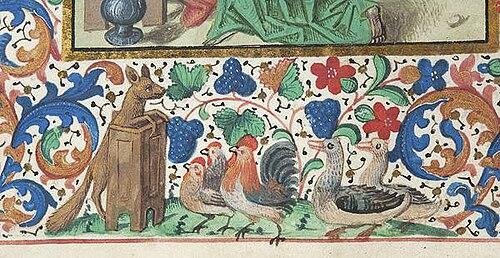
Morgan Ms M485 40v, Pierpont Morgan Library, NYC Wikimedia Commons
We make assumptions about things as humans.
When I ask you to think of a word to describe the chicken, what word do you think of? In this modern day, you might consider her for her taste. You might think of her as a mother to her chicks. Or, you might even consider her a coward. “Don’t be a chicken,” is, of course, what we say when encouraging our friends to do something foolish. The saying isn’t unique to English, either; the Spanish say, “¡No seas gallina!” (“Don’t be a hen!”) and the French take it one step further with “Ne sois pas une poule mouillée!” (“Don’t be a wet hen!”)
These sayings are over four hundred years old, but they didn’t just spring into existence in the seventeenth century. We have this negative opinion and belief towards the chicken because our ancestors did. Human nature is to assign things to patterns and boxes, and the chicken is not safe from this either.
This belief is over 800 years old.
Bartholomeus Anglicus (“Bartholomew the Englishman”), a teacher in Paris, wrote a book in the thirteenth century, the Book on the Property of Things. In it, he calls the hen the most inferior of birds. Her eggs taste terrible, are small or misshapen, and she is too timid, bathing in dust in an anxious way. Her only redeeming feature is that she is a wonderful mother.
The building of bestiaries and other encyclopedias, much like a modern study of history, required understanding and interrogation of earlier works. Bartholomew was not the first nor the last to call hens timid birds. He’s probably taken that opinion from Pliny the Elder, who says hens fear thunder so much their eggs die if there is a storm nearby. They all agree that, despite being a coward, she will die for the chick, if – of course – she remembers to actually sit on the egg. Augustine, Thomas of Cantimpré, the Rochester Bestiary, and Isadore of Seville all mention the hen fighting the Kite, protecting her feeble chicks from the horrible bird of prey.
What makes this particularly fascinating to me, is how contrasting these stories are. They seem like they can not coexist. The hen is a timid creature that can not care for herself; the hen is a monstrously protective beast against anything she deems a threat. Maybe when we say “don’t be a chicken”, we mean to stand up against something bigger, scarier, or more dangerous than we are.
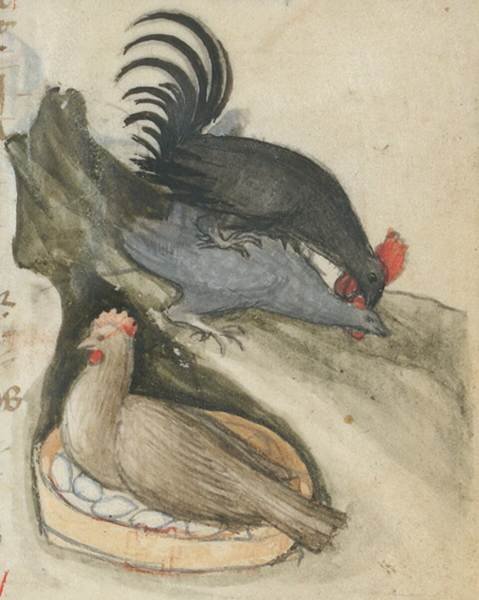
Zürich Zentralbibliothek, Ms. Rh. 172 Parchemin, Wikimedia Commons
This contrast is built into Helaena’s character
To build a character like Helaena Targaryan and bring her into this discussion of chickens is practically genius. The hen is a timid bird, who is unable to stand up for herself, but who is willing to die for her chicks. Helaena is a character who is shown as timid and peaceful in comparison to her relatives (who spend much of the show trying to kill one another), and who is particularly devastated by the death of her young son, Jahaerys. Nonetheless, she is seen as a person with wisdom beyond nature, a fierce dragonrider, and who, at least in her dreams, unleashes dragon fire against those who would cause her surviving daughter harm. The decision to present one of Helaena’s deepest wishes as the unfiltered death of thousands, only to contrast it with her keeping chickens in a field, shows how contrary her character is. In a similar vein, the chicken takes on these two distinct roles which feel like they can not coexist.
Helaena’s characterisation is one of the most medieval aspects of the show.
There is a journey between the medieval bestiary and this modern presentation. We go from Bartholomew the Englishman to Helaena Targaryan because our understandings of the chicken, much like our understandings of wider medieval life, are extremely diverse, and they are informed by the world we live in: what people, places, and situations we encounter, and our exposure to literature, art, culture, oppression, and more. Yet, when you explore it, it does make sense. How else would someone represent a character like Helaena, who is fiercely protective as a mother, but unable to stand up against her son’s killers, if not as a woman who might want to abandon the game of thrones and its politics to keep chickens instead? When the hen represents this fierce motherhood while simultaneously being perceived as timid, the choice to use her in a medieval fantasy adaptation as the ideal, dream scenario for an equally timid yet fierce character makes perfect sense to the audience.
Of course, in that case, Sara Hess, the writer of that episode, almost certainly designed and envisioned Helaena in that way. She’s a highly educated woman who is working in a setting where symbolism, propaganda and medieval iconography are part and parcel with the job. But that the audience also recognises this as a fitting end for the character is proof that medieval bestiaries have a real-world impact and show the value of our words and how we choose to use them. Medieval attitudes do not exist in vacuums any more than modern attitudes do, but they are informed by each other, even when an individual has not personally interacted with the source being pulled from.
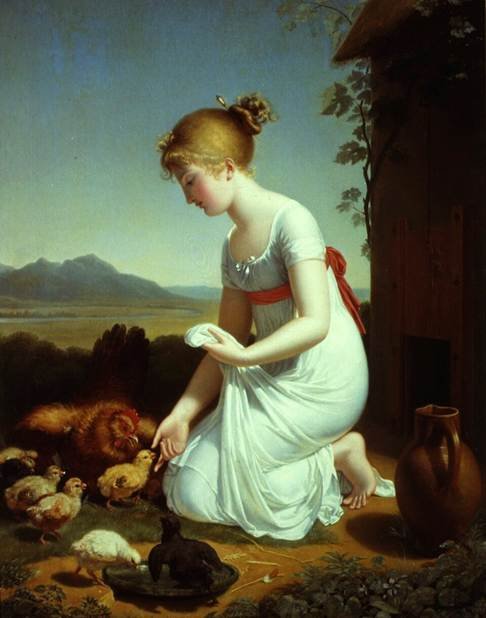
Young Girl Feeding her Chickens, Jeanne-Élisabeth Chaudet, 1802, via Wikimedia Commons
These medieval stories about the chicken lead to modern interpretations.
While it is safe to assume that most laypeople have not encountered a medieval bestiary, the use of media, including television, allows us to make connections – even unconsciously – between these medieval opinions and our modern ones. From sayings to old wives tales, anything can build a connection between one thing and another. I have a special fascination for how longstanding some opinions can be, and how even small changes in history can have large impacts. The focus on chickens as foolish birds (but with good hearts, at least) hasn’t just been presented to modern audiences through House of the Dragon. They represent the real danger in The Truman Show, where every time someone tries to warn Truman of his fate there is a Kaiser chicken advertisement in the background, or in The Menu where the final man to escape the killer chefs hides in the henhouse. These links connect chickens with safety, exactly like Helaena’s desire to keep them does. She might be timid, but she’s more predictable and secure. There is a romanticisation of the hen that is reflective of her presentation in long eighteenth century art, such as James Godby’s Innocent Recreation (1799), William Walker’s Girl With Chickens (1769) or Jeanne-Élisabeth Chaudet’s Young Girl Feeding Her Chickens (1802).
The echoes of history can tell us a lot about ourselves.
Medieval stories leave echoes of themselves in places you might not expect, and in ways people often would say are untrue. To me, the value of studying history, and this does include the history of animals, is rooted in how it increases our understanding of our world and its people – and its animals – today. There is little value in discussing that Bartholomew the Englishman didn’t like hens very much without acknowledging that medieval encyclopedias created an impression on long eighteenth century artists who themselves impacted twentieth and twenty first century television sets. The common threads between societies are more defined than we might think, even in areas of history that may seem irrelevant to a lay person. Most people can accept that war, disease, royalty, political ideology, and such things from the past have had an impact on their lives today, but I think many may balk at the idea that their opinion of the chicken is defined by the opinions of twelfth century writers. Yet humans are more similar than we think, and more static – and this is what makes studying History so exciting.
Sources
Primary
Bartholomaeus Anglicus,trans. Stephen Batman, Batman uppon Bartholome, his booke, De proprietatibus rerum, newly corrected, enlarged and ammended: with such additions as are requisite (London: Thomas East, 1582) https://bestiary.ca/beasts/beastsource102166.htm
Thomas of Cantipré, Liber de natura rerum, Birds 5.58, https://bestiary.ca/beasts/beastsource102166.htm
Matthaeus Platearius, Compendium Salernitanum (Pierpont Morgan Library, MS M.873)
Sextus Platicus, De medicina ex animalibus, folio 89v (British Library: Sloane MS 1975) https://bestiary.ca/manuscripts/manu102683.htm
Secondary
Robert G. Calkins, Illuminated Books of the Middle Ages, (Ithaca, New York: Cornell University Press, 1983)
Marcel Thomas, The Golden Age: Manuscript Painting at the Time of Jean, Duc de Berry, London: Book Club Associates, 1980.


