Hi all. Having never contributed to something like this before, I can only assume I start by saying hello! I’ve been teaching History for nearly 10 years now and, whilst I hesitate to call myself a ‘specialist’ in medieval history, it’s certainly a title that has been foisted upon me over the years. I’m sure those more deserving of the title would simply call me an ‘enthusiast.’ Whilst I don’t claim to be able to provide any novel scholarly insights or new pedagogical techniques, I thought some in the medieval history community may wish to hear from those at ‘the coal face.’
I thought for my first contribution to “Medievaling” I might start by sharing some of the misconceptions that I frequently encounter when delivering the medieval curriculum to children in England. I thought this might be interesting, especially for fellow educators who may not be aware of the preconceptions that often accompany our pupils or students when they begin their studies of the Middle Ages, as they did me. I hope we can also share a little light-hearted chuckle.
Seriously?! The man’s name is Cnut?!
Canute, Cnut, Canute the Great King of England from 1016 until 1035. Instigator of giggles throughout every History classroom for at least the last 50 years. Only somewhat surpassed by his equally successful son, Harthacnut. Both proof that it’s useful for every History teacher to very carefully write names out on the board and check your pupils have read them correctly. I have taught pupils that, years later have approached me in the street and the only thing they remember learning about was King C**t, excellent.
Whilst good for a chuckle, this misconception does point to a wider issue that I believe History teachers are loathe to tackle, I know I am. Spelling. I often, out of frustration, fall into the trap of simply blaming the English department and moving on. The fundamental fact is, History remains one of the few subjects where pupils will still be expected to write for any considerable length of time. Consequently, we do have a responsibility to correct spelling mistakes and make sure that a casual Canute doesn’t mistakenly slip in.
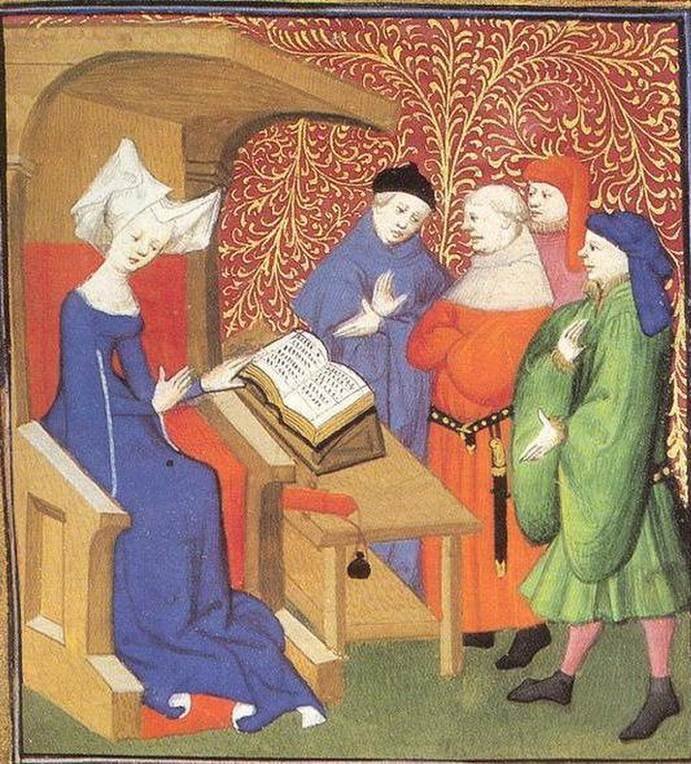
15th century illustration from Giovanni Boccaccio’s De Mulieribus Claris. In the collection of the Bibliothèque nationale de France via Wikimedia Commons
“Why weren’t there any women in the Middle Ages?”
A question that never fails to be asked every year. Whilst this one is less a misconception and more a combination of many factors that are equally important and require addressing. Often we as educators are so concerned with delivering the content that we forget to address some of the easiest to miss ‘gaps’ in our curriculum. The hidden voices and stories that are often overlooked. When delivering the story of the Norman Conquest, how frequently are the experiences of Emma of Normandy or Edith the Fair included in our narrative? When covering the murder of Thomas Becket or the reign of King John, is the name of the formidable Eleanor of Aquitaine mentioned?
Whilst undoubtedly innocent, this failure on our part can lead to a serious misconception amongst our pupils, that women played very little, if any, role in medieval society. Indeed, it’s not inconceivable that the first woman pupils in a secondary school History classroom would learn about would be Elizabeth I. This then forms two misconceptions: women were not particularly important during the Middle Ages, and only the female nobility are worth learning about.
By addressing these two misconceptions early, preferably before they have even been formed, by introducing pupils to the lives of *people* in medieval England, we can hopefully establish that the story of the Middle Ages is not just a story of powerful men and that women are not simply a footnote in that story.
“No-one in the Middle Ages could read or write.”
A favourite statement of history textbook old and new (depressingly) “people in the Middle Ages were illiterate.” That single sentence, I suspect, has done more damage to our collective understanding of medieval England than any other.
Teachers unfamiliar with the period would read that sentence and imagine that only the clergy and Nobility had the ability to read and write, understandably so. It’s a misconception propped up by movies and other entertainment, a common belief amongst the general public that no one could read or write until Chaucer or maybe Shakespeare invented the English language we recognise.
Obviously, this is something that should be addressed as early as possible. Many people could read or write in their vernacular, but were considered ‘illiterate’ by clerical standards because they could not read or write *Latin.*
“So, they were just stupid then sir?”
Possibly the most frustrating but also fundamental misunderstanding that pupils come to about the Middle Ages.
People in the Middle Ages did not have the same understanding about the world around them that we do today and consequently they were “stupid.”. I think this misconception is one that often persists long into a pupils historical education, indeed I have had the same conversation with pupils at age 16 that I remember having with them at age 11. I remember having these same conversations with other undergraduates at university.
Anecdotally, I believe this misconception stems from how fundamentally differently people in the Middle Ages approached the world. The world of the 11th century being so alien to those of us living in the 21st, let alone to children. Their diet, entertainment, religious beliefs, views about women and children, their ideas about science and medicine, all so startlingly different to our modern understanding of the world that the simplest answer is the easiest to understand; they were just stupid. When talking about the medieval church or medieval medicine, I often catch that consternated look that educators up and down the country will recognise, usually swiftly followed by a “So sir, they were just stupid right?”
I believe the term used is presentism, introducing modern values into interpretations of the past. I am aware of the scholarly debate around this topic in a broader sense, and I can’t claim to have found the answer to this one yet; I believe it may be the perennial problem of any medieval history curriculum, but it is something that requires time and effort to explore with pupils. It is also something that educators across the board should look out for and address frequently. Whilst it is assuredly inescapable to view historical events through a modern context, we must be conscious of the many pitfalls it can contribute to, especially in inexperienced learners.
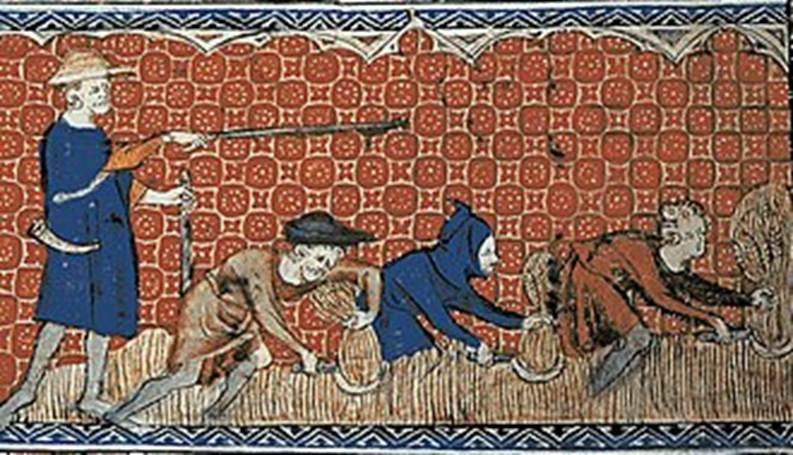
Medieval illustration of men harvesting wheat with reaping-hooks or sickles, on a calendar page for August. Queen Mary’s Psalter (Ms. Royal 2. B. VII), c. 1310 via Wikimedia Commons
“Everyone was dirty and smelly and wore brown and grey rags.”
I come across this fairly frequently when reading pupils’ work, despite the fact it’s never something I have said or alluded to in any way. Another misconception I believe we have Hollywood and other media to thank for. The famous scene from Monty Python and the Holy Grail of Dennis and his lovely spot of mud, whilst satirical, seems to underpin this idea that still seems unshakeable in modern movies today (looking at you Uprising.)
In actuality, the Middle Ages were full of colour, even accounting for the sumptuary laws that frequently failed to regulate things like clothing and luxury expenses. Similarly, whilst regular hot water bathing was something of a luxury reserved for the wealthy, King John famously indulged in a bath once every three weeks! Washing and rinsing were daily expectations for people living in the middle-ages.
Thanks for reading…
These are a few of the more frequent misconceptions that I find to be prevalent amongst my cohort of pupils each year. Whilst I cannot propose solutions to all of them, I thought it may be useful for fellow educators, especially those who are maybe inexperienced in teaching the Middle Ages, to be aware of. This may also prove useful to those of you who perhaps still hold some of these misconceptions, as I know I did, when entering my undergraduate studies.
I hope I will be able to share a few choice teaching methods for specific areas of the Middle Ages and maybe some further insights into teaching medieval History to Key Stage 4 and 5 pupils. As it is the start of the academic year, I am currently full of optimism and big ideas, I shall perhaps change by tune once the May half-term arrives.
I hope this has been a somewhat enjoyable and light-hearted read for those of you who are involved in education or have an interest in following that career path and I hope to share a few more thoughts later in the year.
All the best and keep on Medievaling,
MRA
History BA Hons, PGCE