
In 1017, a widowed queen was summoned to the court of her husband’s conqueror. Emma of Normandy, once the wife of Aethelred the Unready, was now to marry Cnut and be crowned queen for a second time. Emma duly complied and established herself as the only woman to have been crowned in England twice. Emma’s political astuteness ensured she remained relevant in a politically evolving world, as England passed from Anglo-Saxon to Danish rule. In marrying her first husband’s conqueror, Emma survived and thrived.
The Wife of Aethelred
Emma was born around 990, the daughter of Richard, Duke of Normandy. Married as a young teenager in 1002 to the English King, Aethelred, Emma’s first husband had earned the epithet ‘Unraed’, meaning ‘poor counsel’. This Old English term is often misinterpreted to mean Unready, suggesting Aethelred was ill-prepared for the Viking invasions of the tenth and eleventh centuries. The marriage marked a change in Aethelred’s failing policy of paying off the Vikings in exchange for peace, and it was hoped the union would offer England some protection against the Viking invaders. While the marriage did not fully accomplish its intended purpose, it achieved one key objective with the birth of two princes: Edward, later known as ‘The Confessor,’ and Alfred.
Emma and her sons were forced to flee England in 1013 when Swein Forkbeard, King of Denmark, completed his conquest of England. His death in the following year saw his son, Cnut, succeed him as King of both England and Denmark. But Cnut initially showed little interest in his claim to the English throne, permitting Emma and her sons to return to England and for Aethelred to return to the throne. By 1015, Cnut returned to claim England and launched an invasion.
The death of Aethelred in 1016 transformed Emma from a secure position as Queen of England into a widow with two sons who had a better claim to the throne than Cnut. The royal family fled to Emma’s ancestral home, Normandy, for safety.
The Wife of Cnut
To legitimise his kingship, Cnut sought Emma as his bride. By marrying a crowned Queen, Cnut hoped to establish himself on the English throne and to endear himself to his new English subjects. Presented as a passive figure in some sources, Emma was ‘brought’ back to the English court to marry Cnut. She was, however, much more politically aware. In a slightly different version of events, in the Encomium Emmae Reginae, a text commissioned by Emma herself, she had some political agency. Emma only agreed to marry Cnut after he wooed her and promised he would not permit his sons from his first marriage to succeed him, giving precedence to any sons that would come from his union with Emma. Emma’s coronation alongside Cnut elevated her position from a passive consort as the wife of Aethelred to an essential and integral component of Cnut’s authority and kingship.
As the wife of Aethelred, Emma was most often referred to as the ‘king’s wife’ in official documents. As the wife of Cnut, Emma enjoyed the more prestigious title of ‘queen’. The contrast between her two husbands could not have been starker; Aethelred was significantly older than Emma, a ruler from a well-established dynasty, who gave Emma limited scope for independent power. Cnut, on the other hand, was perhaps a little younger than Emma and his inexperience in England meant he relied on her for advice and guidance. His reliance upon Emma for his own legitimacy provided Emma with an opportunity to exercise political authority and enhanced her position at court. Contemporary accounts viewed their rule as a collaborative partnership, a perspective supported by visual evidence indicating that they governed together.
Emma the Widow
Emma’s distinction as the only woman crowned Queen of England twice can be further highlighted by another aspect of her uniqueness. Following Cnut’s death in 1035, Emma lent authority to her son by Cnut, Harthacnut and ruled alongside him. When their regime proved unpopular, her son, Edward, ruled with them in a triumvirate, a unique arrangement in English dynastic history.
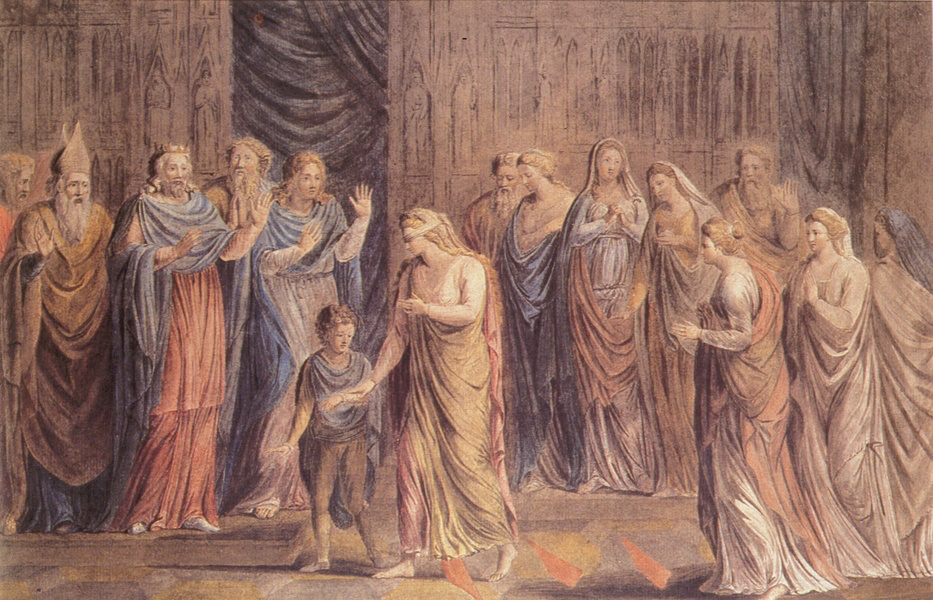
Power would eventually be forcibly wrestled from Emma by Edward, following the death of Harthacnut in 1042, who wished to remove the powerful influence of his politically astute mother. Following his coronation in 1043, Edward had all his mother’s lands confiscated and placed into the possession of the crown. Accusations of a love affair between Emma and Aelfwine, Bishop of Winchester, in Emma’s later years are found in a later twelfth-century source. Allegedly, Emma walked barefoot over nine hot ploughshares to prove her innocence. Although this rumour is not found in any contemporary source, it may have been used to explain the fall of the formidable Emma.
Emma had refused to retreat into obscurity in 1016 and remained politically active until 1042. Emma’s success lay in her ability to operate within the structures of a male-dominated world, securing power through her relationships with kings and heirs. Yet this strategy carried risks: once she alienated her last surviving son, Edward, her position quickly collapsed. Emma’s career reveals not only the possibilities open to a queen in eleventh-century England, but also its limits.
You can read more about Emma of Normandy in my latest book, Trailblazing Medieval Women, out now.
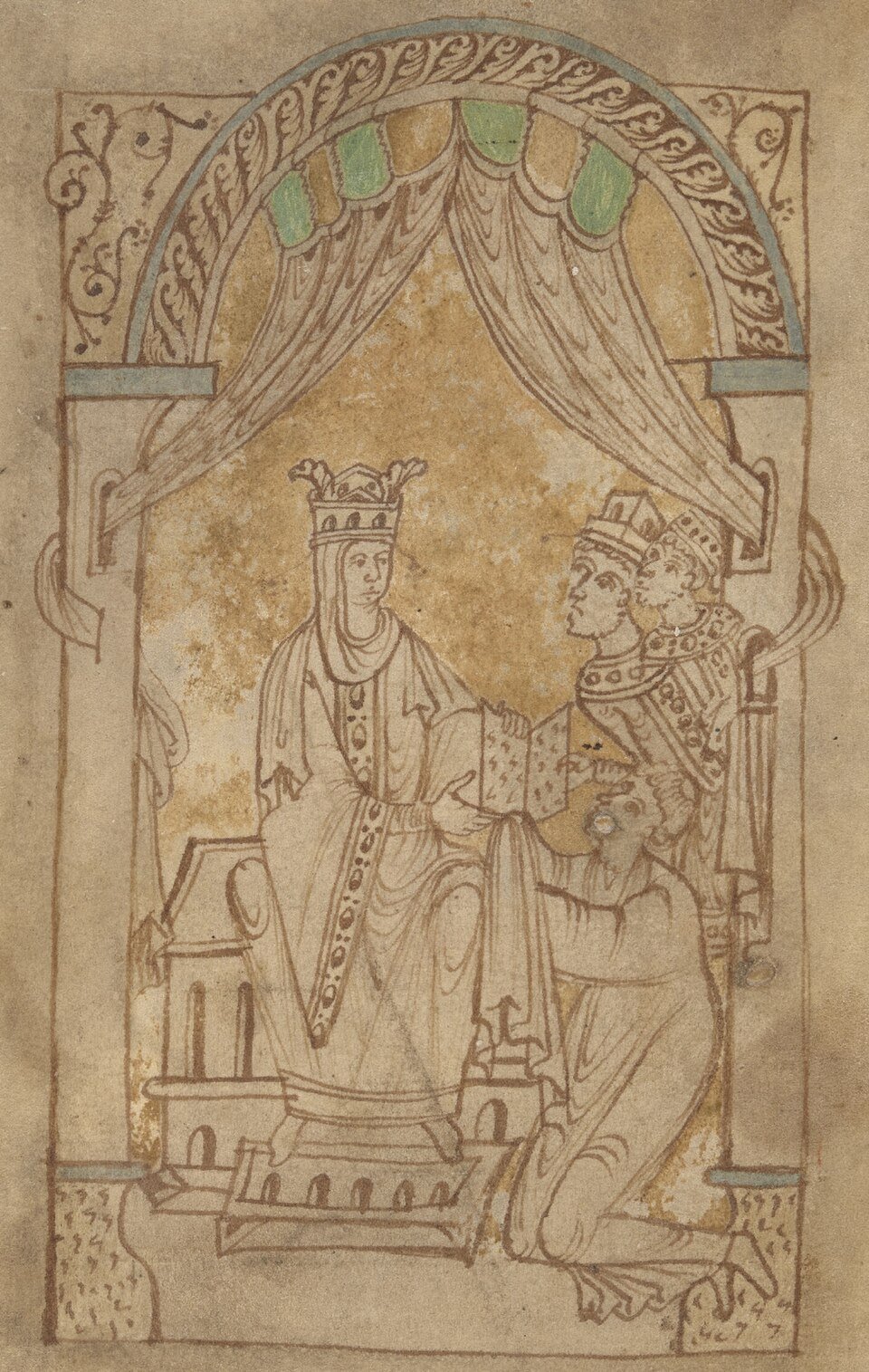
Featured Image: Emma receiving the Encomium, in The Encomium of Queen Emma, c. 1050, British Library MS 33241 from Wiki Commons.



1 comment
[…] depend upon their class. The life of a peasant woman would be rather different from that of a queen. However, all women regardless of class or status performed vital functions in […]