
In this article, we examine Bede’s account of the conversion to Christianity of King Edwin of Northumbria, which took place in 627 AD. Bede recorded this episode in his Ecclesiastical History of the English People. Rather than presenting events in strict chronological order, Bede structures the narrative as a journey. As O’Brien has argued, ‘it is Edwin’s coming to God; and in Bede’s hands, this journey has real dramatic quality.’¹ What follows traces that journey as described by Bede.
Enter Paulinus
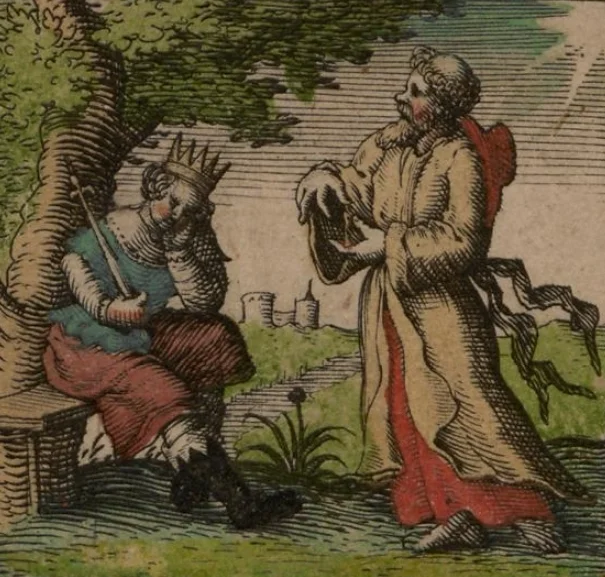
King Edwin, therefore, delaying to receive the Word of God at the preaching of Paulinus, and being wont for some time, as has been said, to sit many hours alone, and seriously to ponder with himself what he was to do, and what religion he was to follow.²
To begin, it is important to consider Edwin himself, alongside Paulinus and his role in the king’s conversion. Edwin was a pagan ruler of one of the most powerful Anglo-Saxon kingdoms. In 625, he married Æthelberg, the sister of King Eadbald of Kent, in order to strengthen political ties. This marriage carried clear religious implications, as Æthelberg was a committed Christian, and there was an expectation that Edwin might eventually convert. Bede records that:
he [Edwin] promised that he would in no manner act in opposition to the Christian faith… nor did he refuse to accept that religion himself, if, being examined by wise men, it should be found more holy and more worthy of God.³
Æthelberg arrived in Northumbria accompanied by her household, including the Roman missionary Paulinus. Paulinus had been sent by Pope Gregory I with the aim of converting the Anglo-Saxon rulers and had already been consecrated as a bishop before entering Edwin’s kingdom.
His presence at court served two purposes. Firstly, he was to ensure that Æthelberg and her followers maintained their Christian faith. As Bede explains, Paulinus was tasked:
‘by daily exhortations… to confirm her and her company, lest they should be corrupted by intercourse with the pagans’.⁴
Secondly, and more importantly, he was expected to bring about Edwin’s conversion. Pope Boniface even wrote to Æthelberg, urging her to encourage her husband to adopt Christianity.⁵
The Implications of Conversion
Despite these efforts, Edwin did not immediately convert. Bede describes how he spent long periods reflecting on his decision, weighing the implications carefully.⁶ This detail is significant, as it allows Bede to portray Edwin as a thoughtful and prudent ruler who does not act rashly.
However, Bede’s account must be read critically. His purpose is to promote Christianity, and therefore, he presents conversion as both logical and inevitable. In reality, Edwin’s hesitation likely reflected genuine concerns. Conversion was not simply a personal decision; it had far-reaching political consequences.
Although it could strengthen ties with Kent, it might also isolate Edwin within a largely pagan environment. His position as king was not entirely secure, and he had learned from earlier experiences how fragile power could be.
King Raedwald
Earlier in his life, Edwin had taken refuge with King Raedwald of East Anglia after being forced into exile. Following the death of his father Ælla around 597, Edwin was displaced from power, and the kingdom was eventually taken by Æthelfrith of Bernicia.⁷
Raedwald initially offered Edwin protection, but his loyalty was tested when he was offered incentives to betray him. According to Bede, it was Raedwald’s wife who persuaded him to remain faithful, arguing that it would be dishonourable to betray a friend for material gain.⁸
Ultimately, Raedwald not only refused to hand Edwin over but also helped him regain his kingdom.⁹ This episode illustrates the unstable nature of early medieval kingship, where alliances were uncertain, and survival depended heavily on loyalty.
For Edwin, conversion to Christianity carried significant risks, potentially weakening his position among pagan allies.
Fortune Favours Paulinus
While Edwin continued to deliberate, two major events provided Paulinus with an opportunity to advance his mission. The first was an assassination attempt arranged by Cuichelm, king of the West Saxons. A man named Eumer attacked Edwin with a poisoned dagger, though the king survived the attempt.¹⁰
At the same time, Edwin’s wife gave birth to a daughter, Eanfled. Paulinus used this moment to attribute the safe delivery to the power of Christ, presenting it as evidence of divine favour.¹¹
Bede emphasises that these events occurred during Easter, reinforcing their religious significance and allowing Paulinus to frame them as proof of Christianity’s truth.
A Further Step Towards Conversion
Following these events, Edwin allowed Paulinus to baptise his daughter:
She was the first to be baptized of the nation of the Northumbrians…¹²
This represented a significant step forward. However, Edwin himself still hesitated. He declared that he would convert if he achieved victory over Cuichelm.¹³
After defeating his enemy, Edwin moved closer to conversion but remained cautious. He sought further instruction from Paulinus and consulted his leading advisors before making a final decision.¹⁴
Bede uses this to reinforce Edwin’s image as a wise ruler who values counsel. At the same time, it reflects the practical reality that Edwin needed the support of his followers, as conversion required collective acceptance rather than an individual decision alone.
Edwin’s Vision
According to Bede, Paulinus ultimately persuaded Edwin by reminding him of a vision he had experienced during his exile. In this vision, a mysterious figure promised him safety, power, and kingship, provided that he followed his guidance.¹⁵
The figure placed a hand upon Edwin’s head and instructed him to remember this sign. Years later, Paulinus repeated the gesture, prompting Edwin to recall the vision and the promise he had made.¹⁶
The Significance of the Vision
This episode raises important questions. It is possible that Bede shaped or included the story to reinforce his message about divine intervention. Alternatively, the story may have circulated among Edwin’s followers as an explanation for his rise to power.
It is also plausible that Edwin himself believed he had experienced such a vision. Paulinus, aware of this narrative, could then have used it effectively to persuade him. By invoking Edwin’s earlier promise, Paulinus provided a compelling argument for conversion.
Conclusion
Bede presents Edwin’s conversion as a gradual and carefully considered process, influenced by political realities, personal experiences, and religious persuasion. Whether understood as history, interpretation, or theological narrative, the account demonstrates that conversion in the early medieval world was complex and deeply consequential.
Footnotes
- C. O’Brien, ‘The Hero’s Journey in Bede’s Ecclesiastical History…’, (2017), p. 364.
- Bede, Ecclesiastical History, Chapter XII, p. 117.
- Bede, Chapter XIII, pp. 107–108.
- Bede, Chapter XIII, p. 108.
- Bede, Chapter XI, p. 113.
- Bede, Chapter XII, p. 118.
- R. Cramp, ‘Eadwine…’, ODNB (2004).
- Bede, Chapter XII, p. 118.
- Ibid.
- Bede, Chapter IX, p. 108.
- Ibid.
- Ibid.
- Ibid.
- Ibid.
- Bede, Chapter XII, pp. 115–116.
- Bede, Chapter XII, p. 117.