
King Arthur is one of the most pervasive myths in medieval history. Popularised by romances like Le Morte D’Arthur by Thomas Malory, the High Medieval Arthur lived in a world of castles and chivalry. But the myths go back far earlier, to a world far different from that of Mallory. They depict a Britain standing in the shadow of Rome, a time of instability and war. Little remains of the British Heroic Age, but through poetry and archaeology, we can get a glimpse into the world that made the legend of Arthur.
The World of Sixth-Century Britain
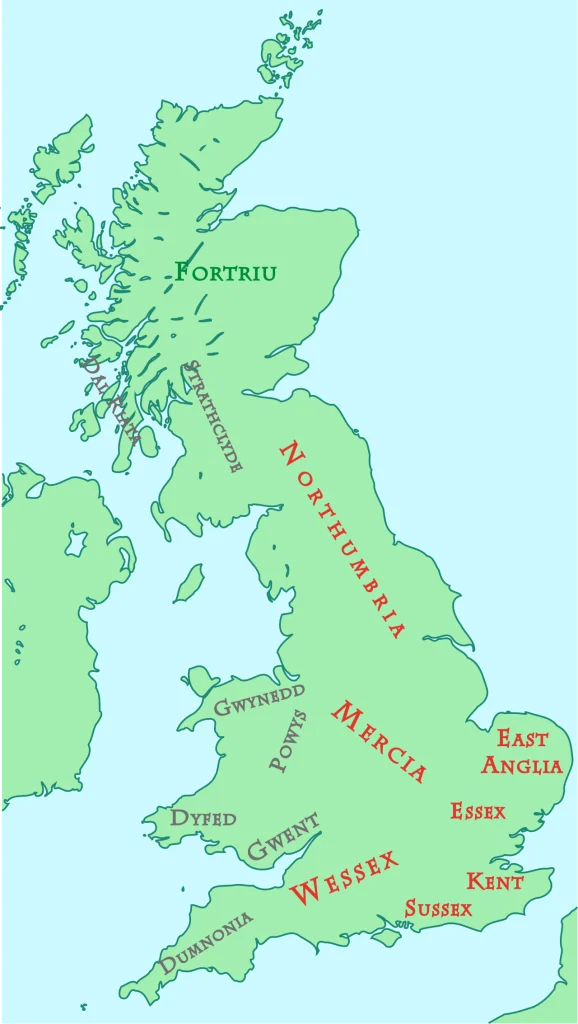
Britain in the sixth century was a patchwork of tiny states. For the previous four centuries, much of lowland Britain had been part of the Roman Empire, and the Imperial system had left an indelible mark on the culture and archaeology of the island, both changing the culture of the native people, as well as bringing influxes of migrants from across the Mediterranean and European worlds. By the mid-fourth century, lowland Britain was dotted with villas and towns that connected them to the wider world. The life of men like St. Patrick, his education as a Roman gentleman, and his father’s role as a civic leader showed how deeply Romanised the Britons had become.
By the dawn of the fifth century, however, Imperial systems were breaking down across the Empire. Britain, being one of the more distant and poor of the provinces, quickly fell out of the Imperial sphere. At the same time, influxes of Germanic and Irish migrants changed the demography at the island. Roman towns like Londinium and Eboracum (London and York, respectively), faded away, and evidence of instability grew. As Robin Fleming points out in her book, Britain after Rome, elite burials changed, with both native and migrant men more often being buried with weapons, evidence that the nature of authority had changed from a civic consciousness to a military one.
The People of Sixth Century Britain
In his magisterial work, Wales and the Britons, Charles-Edwards argues that in 500 c.e., there were five major language groups in Britain; Brythonic (the ancestor of modern Welsh), British Latin, Irish, Pictish, and the network of Germanic languages that would eventually consolidate into English. In 19th and early 20th century scholarship, there was a tendency to view these language groups as direct ethnic labels. While in later centuries, there would be clear and at times intense, cultural divides between
British, English and Gaelic communities within Britain, in the centuries immediately following the collapse of Roman authority, the vague lines of ethnicity and language were far less important than those of status, particularly in the hyper masculine elite world of warriors and kings.
Despite this the languages, and eventual ethnic identities of the sixth century people of Britain generally fell into four geographic regions. The Romano-Britons, the indigenous people of the island, who either spoke Latin, or increasingly Brythonic, were situated largely across the western half of Britain, particularly concentrated in modern Wales, Cornwall, and Cumberland. Modern northeastern Scotland was populated with people known as the Picts, the less Romanized cousins of the Southern Britons. Southeastern Britain, particularly in the modern regions of Essex, Sussex, and Kent, was populated by various Germanic peoples, labelled by Bede as the Angles, Saxons, and Jutes. These migrants, who would eventually become known as the Anglo-Saxons or Anglisc, increasingly became the dominant cultural force on the island, particularly in the eastern regions.
Finally, many regions of Western Britain were raided and colonized by the Irish, who would settle in the early Christian period both in southern Wales and western Scotland. The Irish formed communities, both monastic and royal, throughout the west, including the famed religious community of Iona, and the royal capital that would become Glasgow. It was raiders like this who kidnapped and enslaved St. Patrick, before he would return to the island with the intention of Christianization.
Sutton Hoo and the Death of a Warrior King
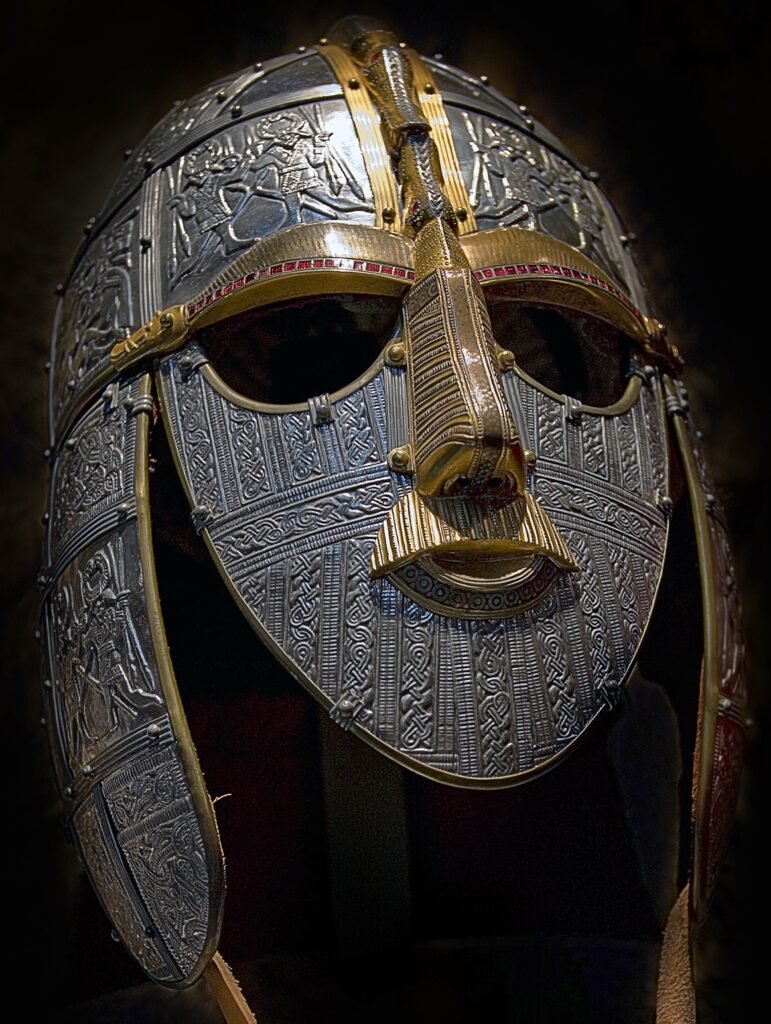
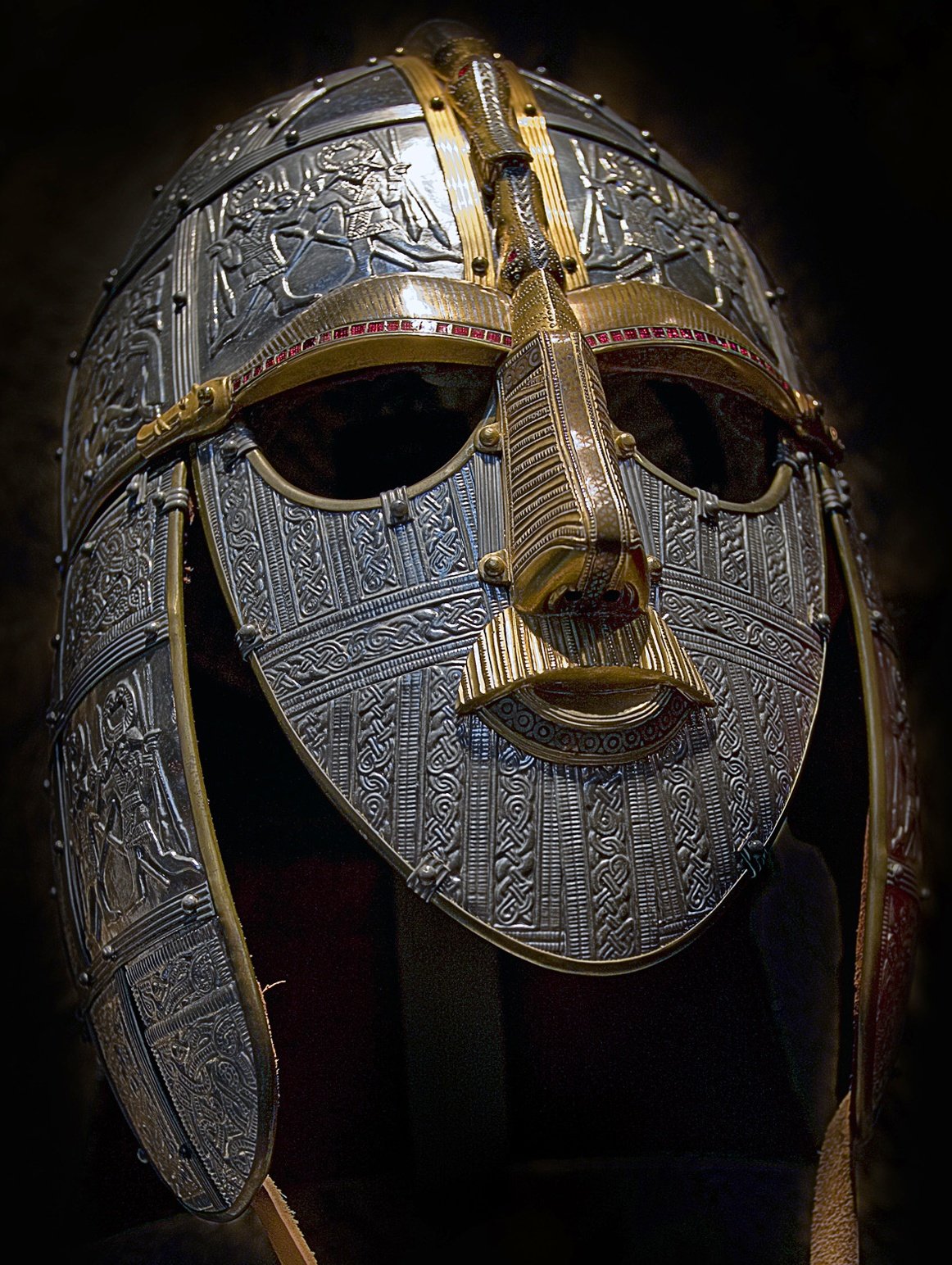
In 1938-1939, amateur archaeologist Basil Brown began excavation work on three burial mounds on Edith May Pretty’s Sutton Hoo estate in modern Suffolk. These mounds were known as ship burials, where high-status Anglisc lords would be buried in a ship filled with their worldly goods, similar to the funeral noted in the poem Beowulf. Over the course of these archaeological digs, Brown and other archaeologists discovered a treasure trove of early medieval artwork, including the famous Sutton Hoo helmet.
The Sutton Hoo trove was clearly meant to denote a person of status, as well as a warrior. The Sutton Hoo Helmet, while likely ceremonial, lends itself to an image of warrior authority, and its expensive gold work and design show someone who could employ expert smiths. While it is still debated who this burial was made for, many scholars argue it was the burial of King Raedwald of East Anglia (560-624).
Britain during this time was a patchwork of kingdoms, and while they were not united, sometimes one war leader could impose their authority enough to make the other kings and leaders subordinate to him in status. The Anglisc referred to this leader as the Bretwalda, and according to the Venerable Bede, author of An Ecclesiastical History of the English People, Raedwald was one such man. According the Bede’s history, he imposed his military authority over much of lowland Britain, making the other Germanic subordinate to him. One of the clearest ways of demonstrating his authority was upon his death.
At his burial, it was expected that every king would appear to pay their respects, and according to Bede, they all did. Raedwald had converted to Christianity near the end of his life, but as even Bede notes, he had both a Christian altar and a pagan temple at his death, and his burial was decidedly pagan. Raedwald was a man who straddled two worlds, one that originated in the dark forests of Frisia that his fathers had come from, and another that stood at the birth of what would become England. When one looks at the Sutton Hoo Helmet, they can see the world the old king inhabited.
Y Gododdin- Poetry and the Death of Heroes
Welsh history is filled with poets and storytellers. In the later medieval period, this poetry and the language of their people would be the fundamental way that the Welsh people would separate themselves from the English. They called themselves the Combrogi, the border sharers, even as the British kingdoms were as divided as the Anglisc ones. But Brythonic poetry is old, as old as the medieval world of Britain. From nursery rhymes like Pais Dinogad to the praise poems of Urien of Rheged, the British people understood themselves through stories.
Y Gododdin is one such poem. Credited to Aneirin, the lone survivor of the battle, Aneirin sings the praise of every man who fought in the battle of Catraeth. Based on what appears to be a real battle taking place around the modern town of Catterick in northern England, Y Gododdin tells the story of a group of warriors who died taking the fortress of Catraeth, often believed to be a settlement of Angles. These three hundred warriors were all killed save one man, the disputed poet Aneirin.
These warriors were likely part of the same teulu, or war party, mostly young men of elite status, who hoped to earn glory through battle. In the lines of the poem, there are references to them being paid in white mead, where their glory would be forevermore. And this poet, Aneirin, tries to give it.
He fed black ravens on the rampart of a fortress
Though he was no Arthur
Among the powerful ones in battle
In the front rank, Gwawrddur was a palisade
In stanza 99, the poet reveres Gwawrddur, one hero of the battle, a great fighter, who ultimately died in the battle among the others. Each stanza is a small elegy to one of the warriors. The stanza of Gwawrddur is often mentioned for being a reference to Arthur. The poem claims to be a rough contemporary to King Raedwald, set around the
early seventh century. Many linguists and historians suggest the poem is indeed from that early date, making this possibly the earliest reference to Arthur.
Y Gododdin exists in the same world as the grave goods of Raedwald, depicting a world of warrior elites. In this intensely masculine world, warriors earned honor through battle even if it meant death. If one reads Aneirin’s poem, one can see the mourning in the death of the boys gone too young. But even still, there is an understanding of this being how British elites understand themselves, as though there were never another choice.
His fate drawing near, which would seek out the old warrior to find the hoard of his soul- Beowulf
In the Early Medieval Period, there were few ways that an elite could note their status. In this chaotic and violent world, where men often died young, and few could read or write, poetry and archaeology were often the ways a person was remembered. Whether British or English, the elites of early Britain viewed warfare as their way to fame, and would pursue it unto death. In this cauldron of violence and bravery, the story of Arthur was forged, the legend who would become the leader of the Round Table.
Bibliography
Charles-Edwards, T. M., R. R. Davies, Geraint H. Jenkins, Kenneth O. Morgan, and Glanmor Williams. The history of Wales. 1: Wales and the britons 350-1064, 2013.
Fleming, Robin. Britain after Rome: The fall and rise, 400-1070. Penguin, 2011.
Koch, John T., and John Carey. The celtic heroic age: Literary sources for ancient Celtic Europe & Early Ireland & Wales. Celtic Studies Publications, 2018.
Anonymous, and George Guidall. Beowulf: Translated by Seamus Heaney. Recorded Books, 2017.
Bede, Bertram Colgrave, R. A. B. Mynors, and Cuthbert. Bede’s Ecclesiastical history of the English people. Oxford University Press, 2022.
Featured Image Credit:
British Museum, CC BY-SA 2.5, via Wikimedia Commons



1 comment
[…] My posts include: https://medievaling.com/true-kinsmen-lost-death-and-honour-in-the-british-heroic-age/ […]