For my latest book, Trailblazing Medieval Women, I chose Isabella of France (c. 1295 – 1358) as an example of a woman who defied contemporary expectations of queenship. Isabella ultimately overthrew her husband, King Edward II (1284 – 1327), in 1326, a king who had become deeply unpopular, largely due to his relationships with two favourites – Piers Gaveston (c. 1284 – 1312) and Hugh Despenser the Younger (c. 1286 – 1326). Edward’s relationship with these two men has become a matter of speculation, and students and history enthusiasts often ask the question, ‘Was Edward II gay?’
A problematic term
As a gender historian, I love this type of question. It allows me to discuss some of the complexities and problems with applying the term ‘gay’ to the Middle Ages. Today, we understand gay to refer to someone’s sexuality, seeking or engaging in a homosexual or same-sex relationship. The first problem we have in applying this term to the medieval period is that no such term existed in the Middle Ages. When describing and condemning a same sex relationship, the term used was often ‘sodomite’. However, this term in itself is problematic. The term was applied to the sexual act itself. Sodomy referred to any sexual act that did not lead to procreation. This term then could be applied to heterosexual relationships and even sex acts that took place between married couples.
The focus on the sex act alone excluded any notion of homosexuality as a lifestyle. The only conceivable sexual relationships were considered to be those between a man and a woman. Although it was understood and acknowledged that what we would describe as same-sex or homosexual relationships did exist, they were not considered to be relationships in the proper sense. Many medieval men were undoubtedly homosexual, but, despite their sexual inclinations, married women and had children. This can especially be applied to kings whose dynastic duty was to provide heirs, and this necessity took precedence over any sexual preference. This often makes such men appear to be invisible in the medieval period.
So, the first issue we have when considering the question ‘was Edward II gay’ is one relating to terminology and an exclusion of the notion of same-sex relationships in the fourteenth century. This quite often makes it difficult to assess the sexuality of anyone in the medieval period. However, we do have some specific clues that might help us to explore Edward’s sexuality in more detail.
Edward’s Character
Contemporaries noted Edward’s unusual character from early in his reign. He was said to prefer the company of tradesmen and labourers as opposed to those of noble rank. In 1315, Edward enjoyed a holiday with common folk and indulged in rowing and swimming. In 1324, Edward went on a fishing trip with a local fisherman and in 1326 was noted to have sailed up and down the Thames that summer, frequently conversing with fishermen and women. Edward also enjoyed blacksmithing and other such hobbies, considered beneath his kingly dignity. One contemporary criticised him for ‘idling and applying himself to making ditches and digging and other improper occupations’. Such affable traits we would now consider commendable in a monarch were considered in the fourteenth century to be utterly shocking and entirely unconventional.
The appearance of a pretender to the throne, John of Powderham, in 1318 raised further suspicions about Edward. Powderham claimed to be the real King Edward, hidden as a baby after he had been mauled by a pig and suffered facial disfigurement. He claimed the present king was a low-born child who had been raised in his place. Although dismissed as incredulous, Edward’s alleged low birth seemed to explain his degenerate behaviour, his preference for commoners and ill company and reflected wider doubts regarding his suitability for kingship.
Edward’s closeness to his favourites, deemed unnatural, gave further rise to concern. His apparent preference for men was taken as further evidence of his unkingly and degenerate behaviour. All of these factors led contemporaries to question his suitability as king.
Had Edward been a conventionally successful king as his father, Edward I, had been, these indiscretions may have been overlooked. But Edward was not as successful in battle as his father had been, and his habit of showering gifts, lands and titles upon his favourites at the expense of the established nobility caused great resentment within the kingdom. Edward and his favourite had upset the balance of power in the relam.
Piers Gaveston
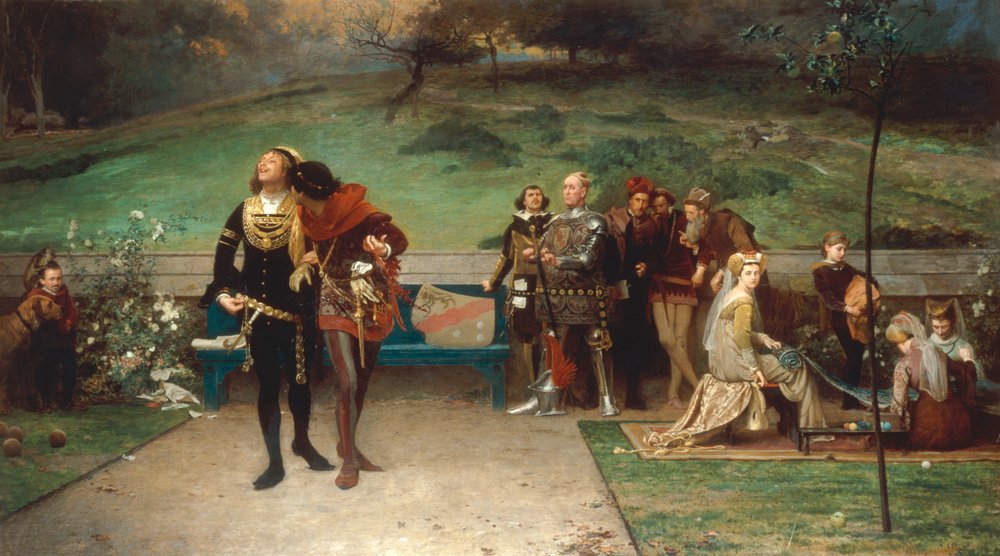
The first of Edward’s favourites was Piers Gaveston. Gaveston was a Gascon knight who was around the same age as the young Edward. Edward I had become worried about the growing close relationship between the pair and had banished Gaveston from the kingdom in the months before the old king’s death. In one of his first acts as king, Edward II recalled Gaveston and made him Earl of Cornwall. Edward married Isabella of France in 1308; the French princess was only 12 years old, and Edward was 23. It is perhaps then unsurprising to learn that Edward spent little time with his new queen during the coronation celebrations. Her uncles complained that the king frequented Piers’s couch more than the queen’s.
One contemporary chronicler, author of the Anonimalle Chronicle, said of Edward: ‘This king loved with all his heart certain people whose company his father had frequently forbidden him, among them a certain sir Piers Gaveston.’ The Westminster Chronicler was a little more explicit. He described Edward and Gaveston’s love as an ‘illicit and sinful union which led to the rejection of the sweet embraces of his wife.’ Other chroniclers used the word sodomite to describe Edward.
Hugh Despenser the Younger
After Gaveston’s execution at the hands of the barons in 1312, a new favourite rose to prominence. His name was Hugh Despenser the Younger. His cruel disposition, coupled with his monopoly over the king, made him unpopular with the barons.
Adam Orleton, Bishop of Winchester, in a sermon in 1326, had accused Edward of sodomy but had later said he was instead referring to Despenser.
When Despenser was executed in 1326 after Isbaella’s successful invasion and deposition of her husband, he was hanged, drawn and quartered. Perhaps indicative of his relationship with the king, his genitals were also removed and thrown into the fire.
Edward’s Death
Edward’s own death is something of a mystery. Found dead in his prison at Berkley Castle in September of 1327, rumours soon spread that he had died after a red-hot poker was inserted into his anus. This was seen to be indicative of his sexual preference. Although it cannot be firmly concluded that this was the manner of Edward’s death, it does indicate that at least some contemporaries considered Edward II to be homosexual.
Was Edward II Gay?
It is very difficult to assess the nature of sexual relationships in the Middle Ages. Edward was likely in a homosexual relationship with Piers Gaveston and then with Hugh Despenser. However, modern historians have challenged such assumptions. Pierre Chaplais (1920 – 2006) argued that the relationship between Edward and Despenser was reminiscent of a brother-in-arms type of relationship. However, such an assumption may reveal more about the prejudices of Chaplais’ time than anything about Edward’s sexual preferences. Or perhaps Chaplais was on to something? As no diaries survive to describe Edward’s personal feelings, we are left to speculate, and perhaps our own assumptions and cultural influences may lead us all to different conclusions regarding the sexuality of Edward II.
References
Johnstone, H., ‘The Eccentricities of Edward II’, The English Historical Review, Vol.48, (1933), p. 265.
Johnstone, H., ‘Isabella, The She-Wolf of France,’ History, Vol. 21, (1936), p. 213.
Haines, R.M., King Edward II: Edward of Caernarfon, His Life, His Reign, and its Aftermath, 1284-1330, (McGill-Queen’s University Press, Montreal and Kingston, 2003), p. 47.
Brown, A.R., ‘The Political Repercussions of Family Ties in the Early Fourteenth Century: The Marriage of Edward II of England and Isabelle of France’, Speculum, Vol. 63, No. 3 (Jul. 1988), p. 583.
The Anonimalle Chronicle 1307 to 1334 From Brotherton Collection MS 29, Childs, W.R. and Taylor, J., eds. and trans. (University of Leeds, Leeds, 1991), pp. 80-83.
Doherty, P., Isabella and the Strange Death of Edward II, (Constable & Robinson, London, 2013), p. 49.