
Few pieces of medieval literature have continued into the public consciousness quite like Dante’s Divine Comedy. Split into three parts – Inferno (Hell), Purgatorio (Purgatory), and Paradiso (Paradise) – it follows a self-inserted Dante through the afterlife. He starts in Hell, where the gates coined the phrase Abandon all hope, ye who enter here. The Roman poet Virgil, a representation of human reason, guides him. Virgil shows him the story of many sinful characters, each of whom suffers a punishment befitting their sins. Fortune tellers have to walk backwards, those who lust are thrown around by a violent storm, and the greedy are forced to joust using great weights as weapons.
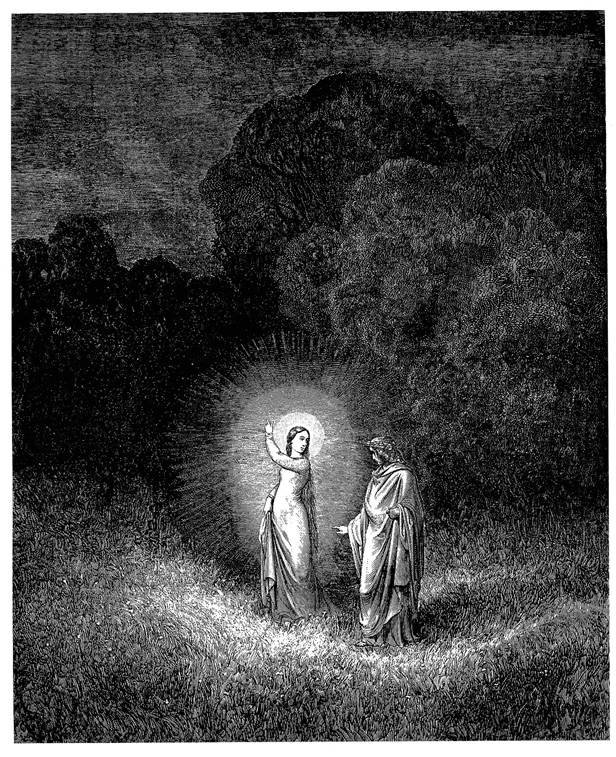
Gustave Doré’s illustration to Dante’s Inferno. Plate VII: Canto II, via Wikimedia Commons
But Virgil is there only because Beatrice asks him to.
Virgil himself has no reason to care for Dante’s soul. He actively tells him that he has been sent by Beatrice, whose divine love has compelled her to fight for Dante.
Beatrice is an interesting character. She is based on a real person, Beatrice Portinari, who is married to another man, and only met Dante twice. Dante was instead married to Gemma Donati, who we know very little about in part because Dante did not see fit to write about her. Giancarlo Lombardi’s analysis of Dante’s work suggests Gemma is the Virgin Mary, but it is obvious that Beatrice is the featured woman of the Divine Comedy, and it is her decision to take pity on Dante and his immortal soul that begins the journey.
Beatrice the woman, Beatrice the character
You can imagine that, for Beatrice Portinari, the presence of her name might be uncomfortable. She has become almost synonymous with Dante at this stage, but as I said, she only met the man twice, and on one of these occasions Dante was only nine years old. This experience was clearly foundational for him.
We can’t ask Beatrice what she thought about being Dante’s muse. She features in his autobiography, La Vita Nuova, as a courtly lady. She would not have seen her presentation in the Comedy, as she died before it was completed. Yet there is something profound about her presence within it. Virgil, the man of logic, can only bring Dante to purgatory. It is Beatrice who represents his salvation, who is able to bring him to Paradise. In this way, Beatrice takes on a form previously held by Christ.
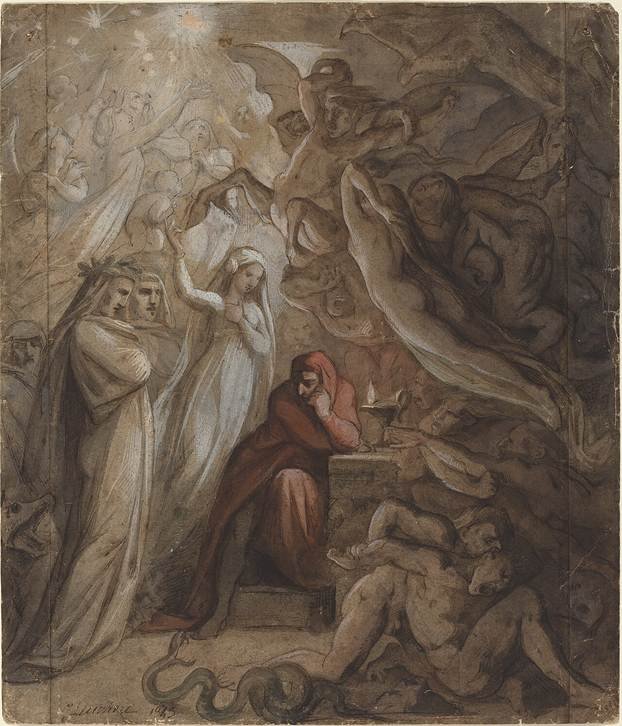
Jean-Jacques Feuchère, Dante Meditating on the Divine Comedy (1843), via Wikimedia Commons
So is it “Bible fanfic?”
If you are a similar age to me, the chances are you’ve been on Tumblr at least once, and possibly regretted it. There is a common belief there that Dante’s work is ‘Bible fanfiction’. I’m not sure this is true to say. It is Biblical in basis, by design of being based around the afterlife, and the fact that Dante is a thirteenth-century Italian. From there, though, it ceases to really be Biblical. The Pope lives in Hell, punished for simony (selling Church belongings). It is a little shocking that Dante does not end up punished for the transgression of this in real life, but as far as I know, he was never excommunicated for it. Today, some would argue that Dante’s decision to put the Pope in Hell is a direct response to the conflict between the Guelphs and Ghibbelines, two opposing Italian factions. But Dante was born a Guelph, the group that typically supported the Papacy. He may have abandoned them later in life, but in his Divine Comedy, he announces himself “a party of himself”, unassigned to either faction.
Not to mention that the Papacy’s main opposition, Frederick II, is in Hell as well in Dante’s works. To minimise the Divine Comedy as some sort of anti-papal propaganda is to misunderstand that Dante is criticising factionalism as a whole. Frederick burns as a heretic in the fifth canto. Not for his excommunication, or for waging war against the Pope, but because Frederick believes that the soul dies when the body does.
Biblical fanfiction is not the right word for it, then. Dante uses the Inferno in particular to criticise what he believes are irredeemable traits. Even his greatest idol, Virgil, is condemned to Hell for his paganism. It is telling that Beatrice does not appear there, and is only available to take on the role of Dante’s guide once he appears in Purgatory.
Beatrice as salvation
It is more accurate, to me, to say that The Divine Comedy is a love letter. Written after the death of a woman Dante loved but could not have, it imagines a world in which she not only waits to greet him, but is the reason entirely that he is able to get to Heaven. Beatrice’s investment in Dante’s salvation is the ultimate gift to be given from her, and her active role in the movement of the story is not seen as an outlier of the chivalrous woman, but as its completion. It is not too far to say that Dante redefined literature in his composition. It is one of the reasons Tuscan Italian is the Italian we recognise and speak today.
God does not care to redeem Dante, the Pope can not help him. Only Beatrice can save him. Dante redefines literature, and Beatrice is unaware she is the cause. His love for her, however misguided, however misattributed, was so intense that it could not be confined by the norms of creation nor the norms of his political or religious status. In this sense, you can read The Divine Comedy as a love letter, wrapped in a political manifesto in order to seem more palatable as a storyline. (It reminds me, in this way, of stories like Lord of the Rings, where the female lover of the male author becomes a key part of the story, placed on a pedestal, while it discusses a much heavier topic.)
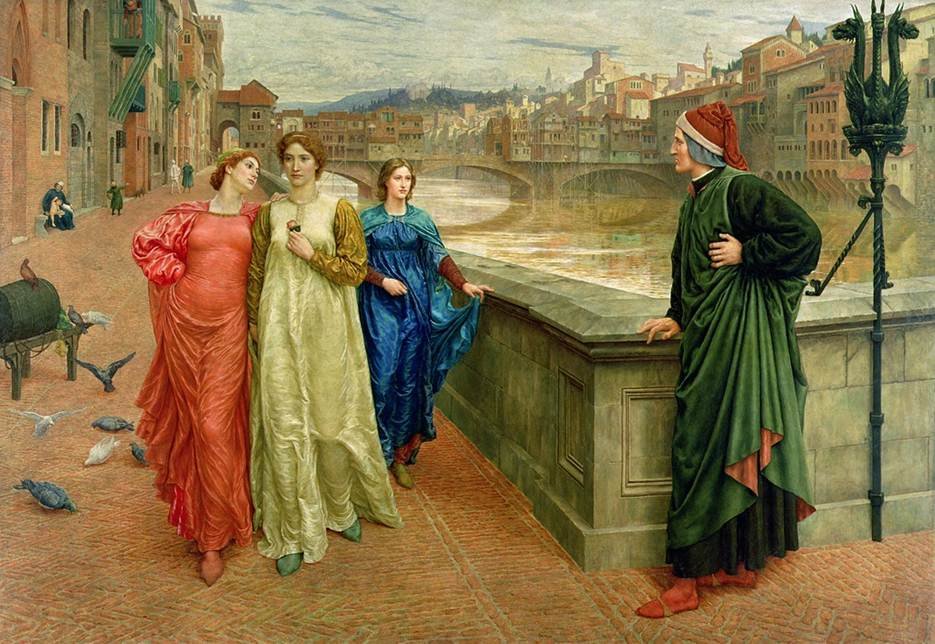
Henry Holiday, Dante e Beatrice (1883) via Wikimedia Commons. Note that Beatrice is the central woman (the only one not looking at him)
But then you have to consider, is it really love?
I would instead protest that we should read The Divine Comedy through the lens of social history. Its politics and religious beliefs are foundational, and like many, I studied it in my medieval history modules of university. Yet, when I suggested it was a social history, an exploration of emotion, I amused my classmates.
And unfortunately, I say emotion, because I don’t believe Dante loved Beatrice. He loved her enough to write a story where she is salvation, akin to Christ himself. He loved her so much that her name is still remembered seven hundred years later. He even loved her enough to place her in a story where the only love she feels towards him is divine. She is not tied to earthly affection, but gives voice to the unconditional love and forgiveness expected of the most pious Catholic.
Yet, even with this, I do not think love is the word. The word is obsession. Dante’s love for Beatrice has been called star-crossed, beautiful, even strange. It has been the focus of artwork for centuries. The truth is much less beautiful: Dante loves an ideal. He loves a character. He loves his invention. Dante did not love Beatrice Portinari. He did not even truly know her. And neither do we.
Sources
Lansing, Richard (editor), The Dante Encyclopedia (New York City: Garland Publishing, 2000)
Lepschy, Anna Laura & Lepschy, Giulio, The Italian Language Today (New York City: Psychology Press (part of Taylor & Francis), 1977)
Lombardi, Giancarlo, L’Estetica Dantesca del Dualismo (in Italian) (1st ed.) (Borgomanero, Novara, Italy: Giuliano Ladolfi Editore, 2022)


