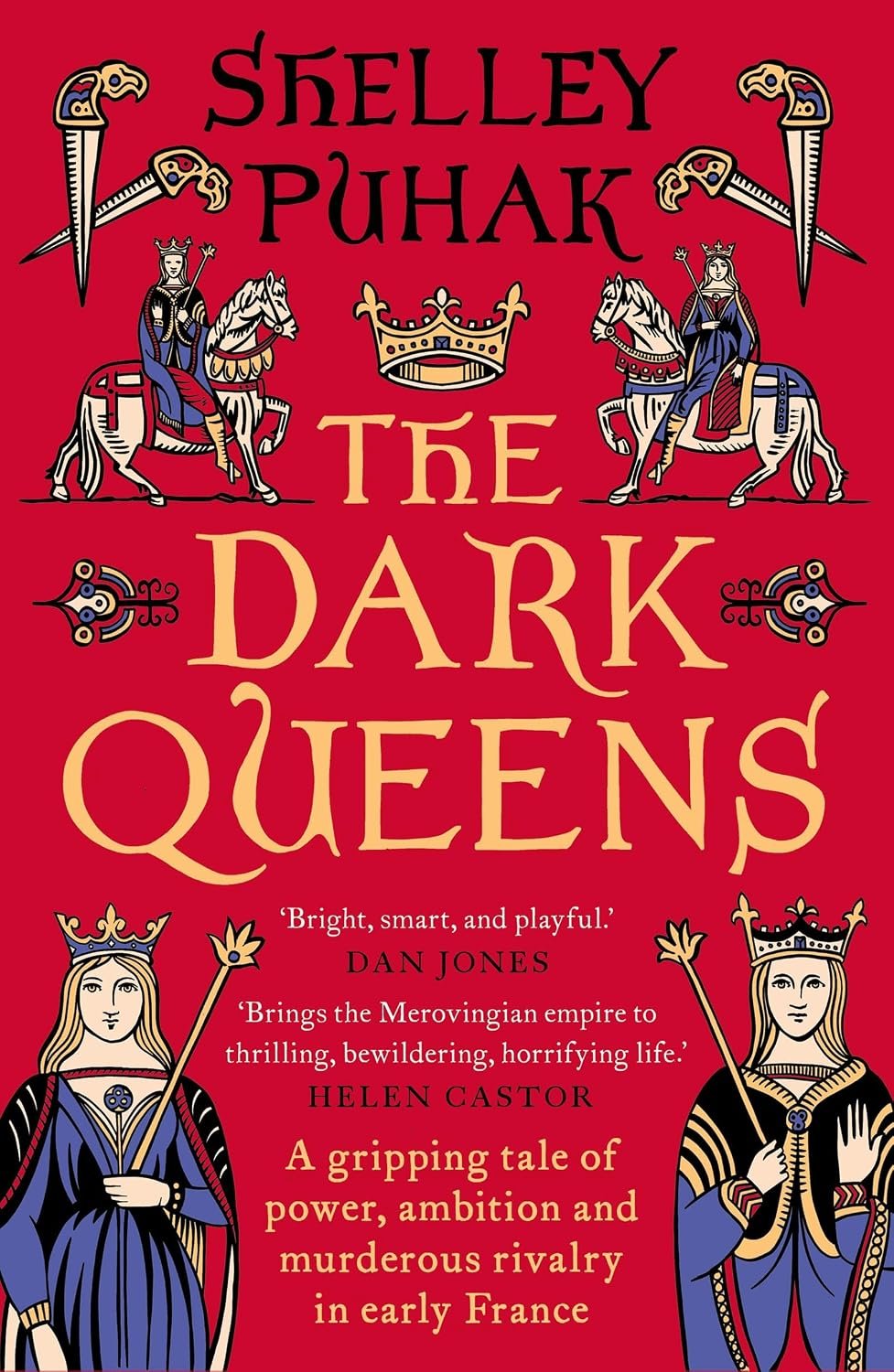
So often when we learn of the early middle ages, we talk of kings, warriors and churchmen. We learn of them as singular individuals who crash through life, warchiefs who dominated a fundamentally masculine world. If women are included in these stories, they’re depicted as passive figures in this world, queens and nuns, daughters and wives, ultimately people who are buffeted along by the whims of the men around them. While it is not groundbreaking to point out that women have been written out of so many parts of history, it is a far more interesting question to see what we can learn about their lives and actions.
In The Dark Queens, Shelley Puhak looks at the lives of two women living in the late sixth century, Fredegund and Brunhild. These two women, queens of the different Frankish dynasties who fought for supremacy, have appeared again and again in French and German history. They’ve appeared in the chronicles of Gregory of Tours, the German Romance Niebelungenlied, and even in the stage operas of Wagner. In these sources, they are so often forced into the role of manipulator or lover, their story defined by their relationship to the male heroes. But Puhak puts these two queens in their own context, as dynamic political leaders of their age. In filling the gaps in their stories, the author tells us about the world they inhabited, with far more depth than any sixth-century chronicle could.
Married into a Viper’s Nest
Western Europe in the second half of the sixth century was a place defined by instability. Warlords jockeyed for power, while local communities strived to enforce some sort of stability on their lives. Nowhere was this clearer than in the realm of Frankia, covering much of modern-day France and Germany. In the beginning of the sixth century, this kingdom had been united under Clovis, the founder of the Merovingian dynasty. But upon his death, he divided his realm amongst his sons, a tradition that would cause no end of strife throughout Frankish history. The fractured kingdoms became known as Austrasia, roughly centred around modern Germany, and Neustria, centred around modern Paris in France. Frequently, the siblings and descendants of Clovis would turn to civil war and violence, until it was rare that these different kingdoms would ever unite, and even rarer that a Merovingian king would die peacefully.
Puhak brings us into the late sixth century, where this pattern of violence had become truly entrenched. For a time, the kingdom of Frankia had been united, under Clothar, son of Clovis, after he killed all his rival siblings. However, in the 560s, his three sons once again divided the kingdom between three young noblemen. Austrasia was ruled by one grandson of Clovis, Sigebert, while Neustria was ruled by his brother Chilperic. And here is where we meet our protagonists.
Brunhilda was the daughter of the Visigothic king and queen, born sometime around 543 C.E., Brunhilda was educated and raised in Toledo, the centre of the Visigothic kingdom. By all accounts, she was well read and extremely intelligent, raised as an Arian Christian. Sometime in her mid twenties, she was married to Sigebert of Austrasia, soon joining him in Metz. They would go on to have three children, and from what we can tell from Gregory of Tours, Sigebert took the advice of his wife fairly regularly, as evidenced by later events.
Chilperic, King of Neustria, was apparently jealous of his brother’s new marriage. He went to Toledo soon after, and married Brunhilda’s sister, Galswintha. Their marriage began happy, but soon the king of Neustria grew tired of the marriage, and conspired to murder her with his consort, Fredegund. Unlike Brunhilda, Fredegund did not come from an important family, instead being a lady’s maid for a previous queen. Puhak even suggests she may have been a slave woman, who later became involved with Chilperic. Either way, in 568, Galswintha was murdered by an unknown assassin, almost certainly on the orders of Fredegund and Chilperic. This sparked a series of civil wars across the Frankish kingdoms, this time centered around the motivations of these two queens.
Brunhilda never forgave the murder of her sister, and Puhak’s book details the wars and intrigues of the two queens over the following decades. She follows the wars they orchestrate between their husbands, and both of their husbands’ assassinations. In the wake of those deaths, Fredegund and Brunhilda took over as regents, protecting their children and jockeying for position between their two kingdoms. Along the way, they governed, arbitrated justice and dealt with the church They would both raise sons to be kings, eventually dying in the pursuit of their goals. Throughout the story, both Brunhilda and Fredegund often come across as ruthless, though not without their humanity. One can find the actions of these figures unpleasant, while still understanding their motivation, and the world that made them. While Puhak works hard to show these figures’ motivations, she depicts them as embodying the same dynastic violence as their husbands and other Franks around them.
One of the largest themes that comes through the story is the violence and instability of the age. One moment a king can be a conquering hero, and in another, they’re destroyed by two assassins that no one ever successfully identifies. Queens can raise their sons to be conquerors, rule the realm for decades, before being publicly executed in front of jeering crowds. Fredegund and Brunhilda are able to take control of their own fates, even in this hyper patriarchal world, largely due to the likelihood of their husbands and sons dying young. In many ways the world of sixth century Frankia brings one to mind of Game of Thrones, and Puhak certainly seems aware of that comparison.
The Author’s Challenge
The author is very honest about the most challenging part of her book. The sixth century is not a time that is well understood at the best of times, but the lives of two women, much maligned by later historians, leaves even less to pull from. The closest contemporary chronicler is Gregory of Tours, no friend of either woman, and according to Puhak, something of a suspect source. She is particularly wary of his writing and role in the trials and church doctrines that Fredegund finds herself in. Puhak sidesteps much of this problem by filling in experiences that one could imagine our two protagonists feeling throughout the story.
The Dark Queens is a popular history, meant to introduce the characters and times to an audience who likely wouldn’t have much background. Puhak is an engaging writer, and threads the historical context together with an engrossing narrative throughout. She is lighter on sources and rigorous scholarship, but as mentioned above, the subject matter she is dealing with makes that all the more difficult. Puhak ends her book with the long after life of these two women, from the medieval romances to the plays and symphonies written for them. Through all of this, she does as much as she can to reveal the real historical figures behind these stories, and the women who really lived.