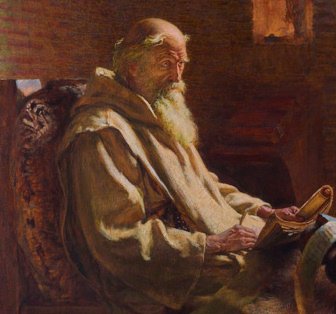
Bede is frequently described as the “Father of English History”, a title that carries considerable prestige. Yet who was Bede, and why has he been granted such a distinction?
Bede the Monk
Bede was a Northumbrian monk, born around 673 and dying in 735 AD. He remains the only Englishman to have been declared a Doctor of the Church, a title awarded by Pope Leo XIII in 1899 in recognition of his theological contributions. He is often referred to as “the Venerable”, a designation representing one of the early stages towards sainthood. Although Bede was never formally canonised, sanctity in the early medieval period was often shaped by local devotion rather than official recognition.
Indeed, Bede was regarded as a saint not long after his death. At the Council of Aachen in 836, he was praised as an “honourable and admirable teacher” and considered comparable to the Church Fathers.¹ His reputation continued to grow, particularly during the monastic revival of the tenth century. By the fourteenth century, Dante placed Bede in Paradise alongside figures such as Isidore of Seville.
Bede entered the monastery at Monkwearmouth at the age of seven, having been entrusted to Benedict Biscop, Abbot of St Peter’s. He spent the rest of his life within the twin monasteries of Monkwearmouth and Jarrow. As a child oblate, derived from the Latin oblatus, meaning “offered”, he had effectively been dedicated to God by his family.
Although a church council at Toledo in 656 had attempted to prohibit the admission of children under ten into monasteries, the practice continued throughout much of the medieval period. Bede was ordained a deacon at the age of nineteen and later became a priest at thirty.
Very little is known about his family background, though it is likely that he came from an aristocratic household. Entry into monastic life often required a financial contribution, similar to a dowry, which supported both the individual and the monastery.
The Monastic Environment
Modern perceptions often imagine monasteries as austere and bleak, yet in the early medieval period they could be relatively comfortable and even impressive. The buildings at Monkwearmouth and Jarrow were particularly notable, as they were constructed in stone rather than wood, making them among the earliest Anglo-Saxon stone structures. These monasteries would have been well-lit, decorated, and comparatively warm environments.
Monastic communities were centres of learning and culture, attracting visitors from across Europe. Their appearance and resources were, in part, designed to appeal to aristocratic recruits. The scale of Monkwearmouth-Jarrow was also considerable. When Abbot Ceolfrith departed for Rome in the early eighth century, he left behind approximately 600 monks and took 80 with him.
Daily life was structured around the Divine Office. Monks spent their time in prayer, chanting psalms, studying, and undertaking manual labour. Physical work was regarded as an important exercise in humility. Individuals were encouraged to develop their talents; in Bede’s case, this meant scholarship and writing. Producing texts was itself an act of devotion, a means of praising God.
Bede had access to one of the most significant libraries of his time. While modest by modern standards, the collection at Monkwearmouth-Jarrow—around 150 books by approximately 70 authors—was exceptional. It included classical texts, writings of the Church Fathers, and works on subjects such as science, music, law, and history.
Bede the Author
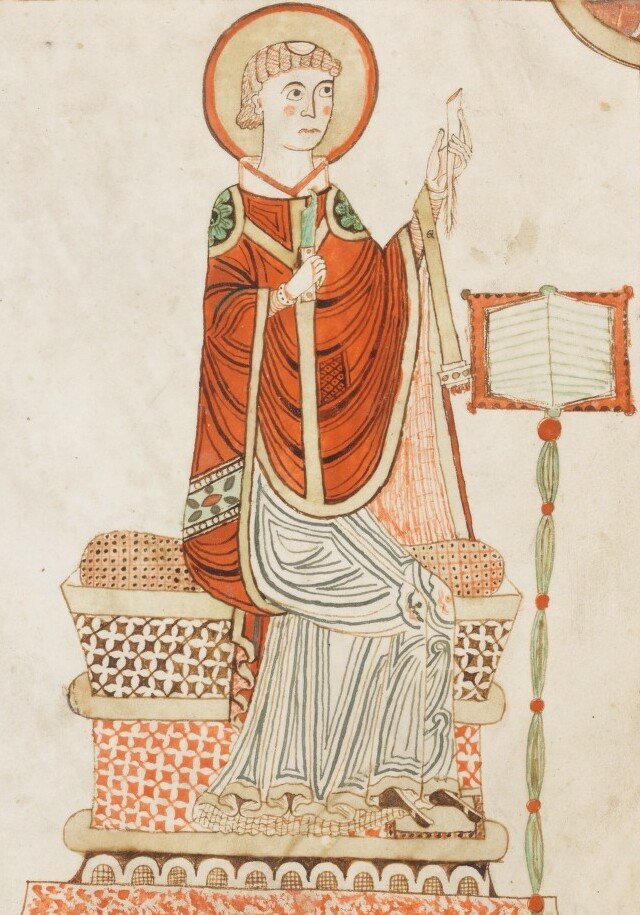
Within this scholarly environment, Bede began writing, likely in the fifth decade of his life. He produced more than thirty works, including biblical commentaries, educational texts on grammar, and a translation of the Gospel of John into English.
However, his most famous work is An Ecclesiastical History of the English People, completed in 731.
The Ecclesiastical History of the English People
Bede begins his work with a description of Britain—its geography and natural features—before opening his narrative with the arrival of Julius Caesar in 55 BC. He then traces events through to his own lifetime, concluding with contemporary issues such as the debate over the correct dating of Easter.
The work is divided into five books:
- Book I: 55 BC – 603 AD
- Book II: 604 – 633 AD
- Book III: 633 – 665 AD
- Book IV: 664 – 698 AD
- Book V: 687 – 731 AD
This text provides much of what is known about early medieval England, and its importance cannot be overstated. Around 160 manuscripts survive from the medieval period, an exceptionally high number. By comparison, works such as Beowulf survive in only a single manuscript.
Bede’s influence extended beyond England. Missionaries on the continent requested copies of his work to assist in the conversion of Germanic peoples. One surviving manuscript held at Cambridge was produced within a decade of Bede’s death, demonstrating the immediate popularity of his writing.
In many instances, Bede preserves information found nowhere else, including detailed accounts such as the conversion of King Edwin of Northumbria.
Why Is Bede Called the Father of English History?
In his Ecclesiastical History, Bede sought to present a coherent account of the development of the English people within a Christian framework. It is important to recognise that in the eighth century, England was not a unified kingdom but a collection of separate realms.
These included Anglo-Saxon kingdoms, alongside territories inhabited by Britons and Picts. Bede himself lived in Northumbria, one of the most powerful of these kingdoms. While many Anglo-Saxon rulers had converted to Christianity by his time, some remained pagan.
Bede interpreted the history of these peoples through the spread of Christianity, presenting conversion as a unifying force. In his view, a shared religious identity played a key role in the emergence of the English people.
In doing so, Bede was not merely recording events; he was shaping how the English past would be understood. His work contributed to the development of a sense of English identity and helped define the historical narrative of early medieval England.
Further Reading
Bede, The Ecclesiastical History of the English People.
P.H. Blair, The World of Bede (1990).
N.J. Higham, ‘Bede’s Agenda in Book IV of the Ecclesiastical History…’, Journal of Ecclesiastical History (2013).
N.J. Higham, (Re-)Reading Bede (2006).
B. Yorke, The Conversion of Britain (2006).