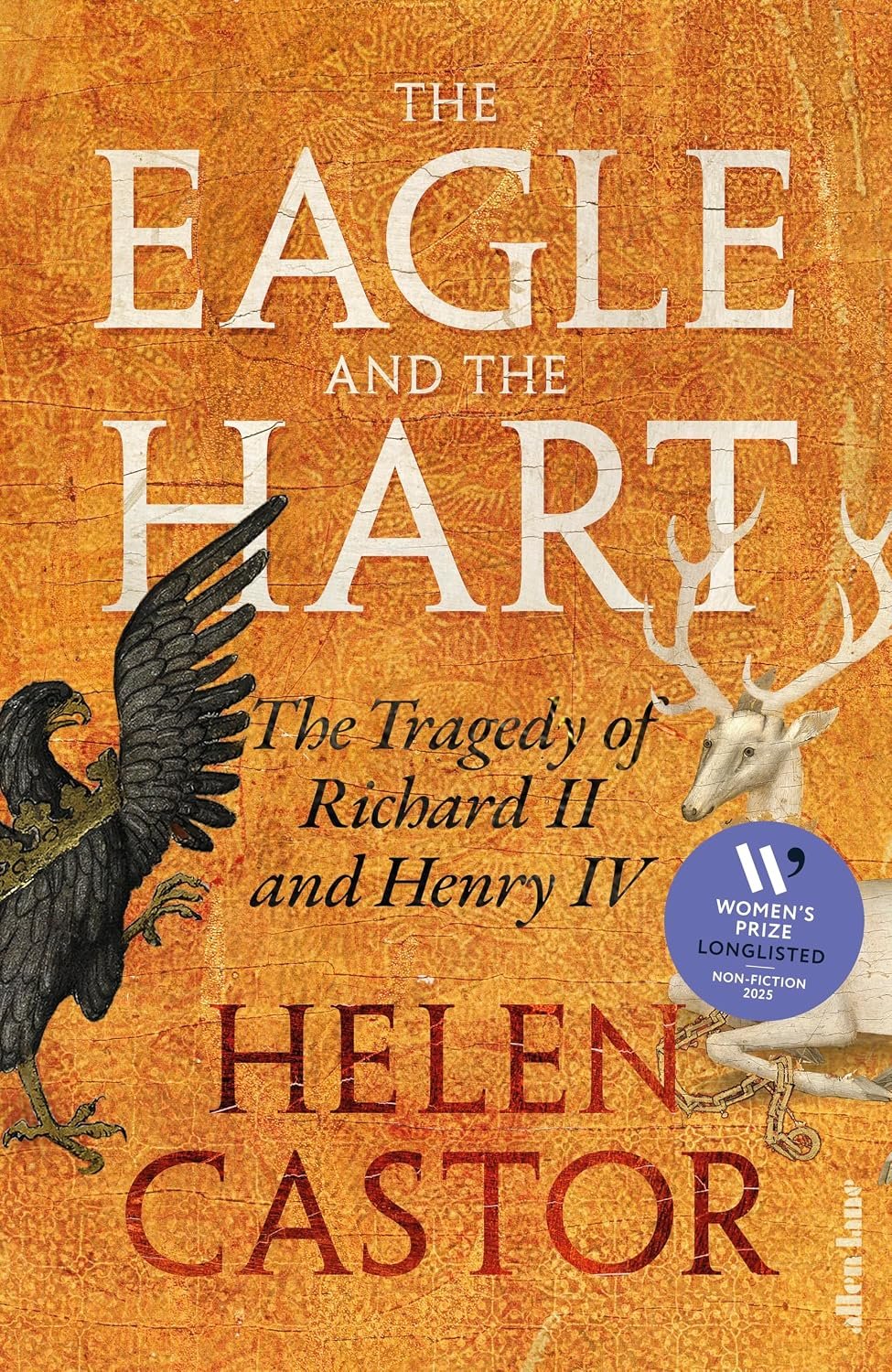
I needed a book to keep me company this summer, and I was pleased that I chose The Eagle and the Hart: The Tragedy of Richard II and Henry IV by Helen Castor to do just that.
Helen Castor
Helen Castor is a British Historian and broadcaster. Her research interests lie primarily in the medieval a nd Tudor periods.
Before writing my first book, Trailblazing Medieval Women back in 2025, I read Helen Castor’s She-Wolves: The Women Who Ruled England Before Elizabeth from front to back. Not only did she offer a well-researched book on several of the women I was researching, but I also enjoyed her style of writing. Lots of complex information was clearly presented in a way that made the book entertaining to read. I was very excited to pick up another one of her works!
The Eagle and the Hart: A Review
The Eagle and the Hart focuses on the lives of King Richard II and King Henry IV. These men were cousins but led two very different lives and had two completely different reigns. The juxtaposition of these two men is neatly illustrated throughout the book, while their respective emblems, Richard’s hart and Henry’s adopted eagle, are effectively incorporated into the book cover.
Richard became king at the age of 10 and developed something of a god complex. Castor traces the potential reasons for the superiority complex developed by Richard, which went far beyond conventional kingly behaviour, engagingly and delightfully.
Richard’s relationships with members of his family are carefully explored, thereby bringing a very medieval king to life. The way that Richard engaged with his advisors and those upon whom he became reliant is also analysed, bringing a degree of humanity into the otherwise tyrannical picture we have of Richard.
The development and deterioration of the relationship between Richard and Henry is traced over the decades, offering a clear explanation of how their relationship became so fractured. Castor emphasises their polar-opposite characters and shows how, as the years wore on, these differences pushed the two men further apart. Henry was everything Richard was not, and I enjoyed reading how Castor presented the differences between these two fascinating figures.
Henry’s reign following Richard’s deposition is explored in some depth, with Castor highlighting how Henry’s guilt over the role he played in Richard’s death influenced the rest of his life. It was particularly interesting to consider how this guilt manifested itself in the realm of realpolitik.
Castor effectively uses primary sources throughout the book to bring the narrative to life and allows us to hear the voices of the characters whom she analyses. A twelfth-century historian at heart, I am not all too familiar with the events of the late fourteenth century, which is one of the reasons I chose this book. The Eagle and the Hart certainly broadened my knowledge of this fascinating period in English history. The book runs in chronological order, making it incredibly easy to follow the narrative. It is perfect for students of the fourteenth and fifteenth centuries as well as those wanting to broaden their knowledge of the medieval period.
For similar posts, see our Book Reviews Category.