Edward IV, Elizabeth Woodville, and the Secret That Shook the Yorkist Court
In September 1464, a revelation emerged from the court of King Edward IV that would astonish members of England’s political establishment and challenge the expectations surrounding its newly established Yorkist monarchy. For months, the question of whom the young king would marry had been a matter of considerable importance, with the prospect of a foreign princess offering an opportunity to strengthen alliances and secure the future dynasty whose crown had been won through years of civil war. Yet while powerful men contemplated the political advantages of a royal marriage, Edward had already made a decision that would confound their expectations, concealing a secret whose consequences would reach far beyond the walls of his court.
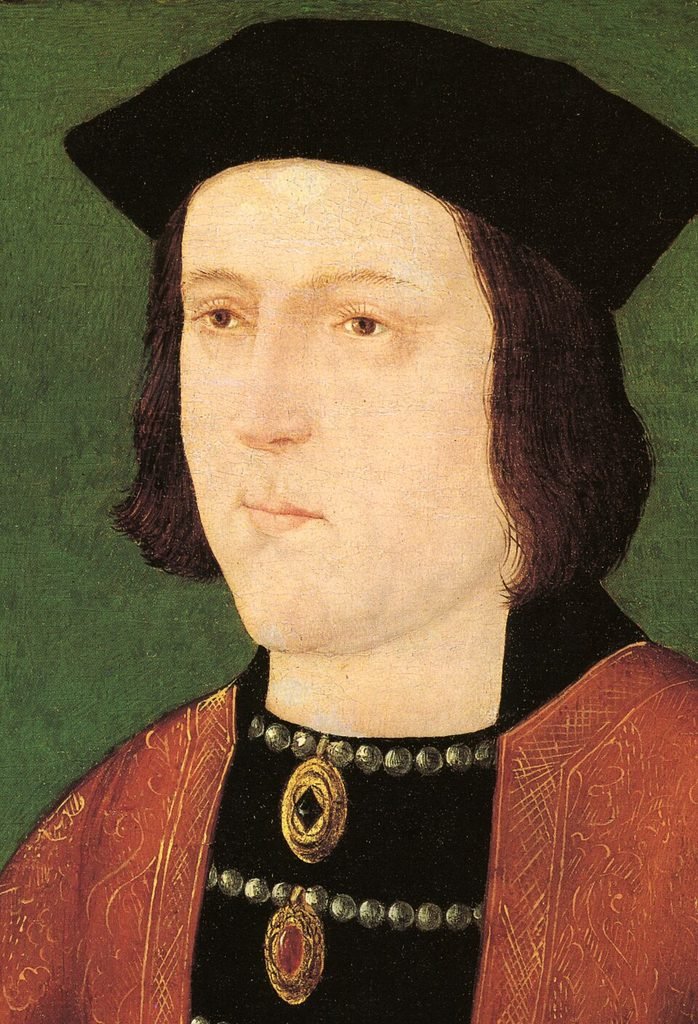
Edward IV (1442-1483), unknown English artist, c. 1540.
National Portrait Gallery, London (NPG 3542). Image via Wikimedia Commons.
The King of England had secretly married a widow whose first husband had died fighting for Edward’s enemies.
She was neither a foreign princess nor the daughter of a reigning monarch, but an Englishwoman with two young sons and connections to the very Lancastrian cause Edward had fought so fiercely to defeat. Her name was Elizabeth Woodville, and the extraordinary circumstances of her marriage would draw her into the dangerous world of royal ambition, political rivalry, and dynastic conflict, where the fortunes of even the most powerful could change with astonishing speed.
To understand how a young king, whose reign had been shaped by the dangerous loyalties of a divided kingdom, came to make a choice that defied so many expectations, the story must begin not with a wedding, but with a crown won on the battlefield and a widow whose future had been transformed by war.
A Crown Won, a Husband Lost
The winter of 1461 found England gripped by a conflict that had already claimed the lives of some of its most powerful noblemen, as the rival houses of Lancaster and York struggled for control of a kingdom whose political divisions had deepened into open warfare. At the centre of the struggle stood Henry VI, a king whose periods of incapacity and inability to command the loyalty of his subjects had helped plunge the realm into crisis, while the ambitions of Richard, Duke of York, and his supporters had transformed disputes over royal government into a contest for the crown itself. Yet by the beginning of the year, Richard was dead, killed at the Battle of Wakefield in December 1460, leaving his eighteen-year-old son Edward to inherit not only his father’s claim to the throne, but the dangerous responsibility of carrying forward the Yorkist cause.
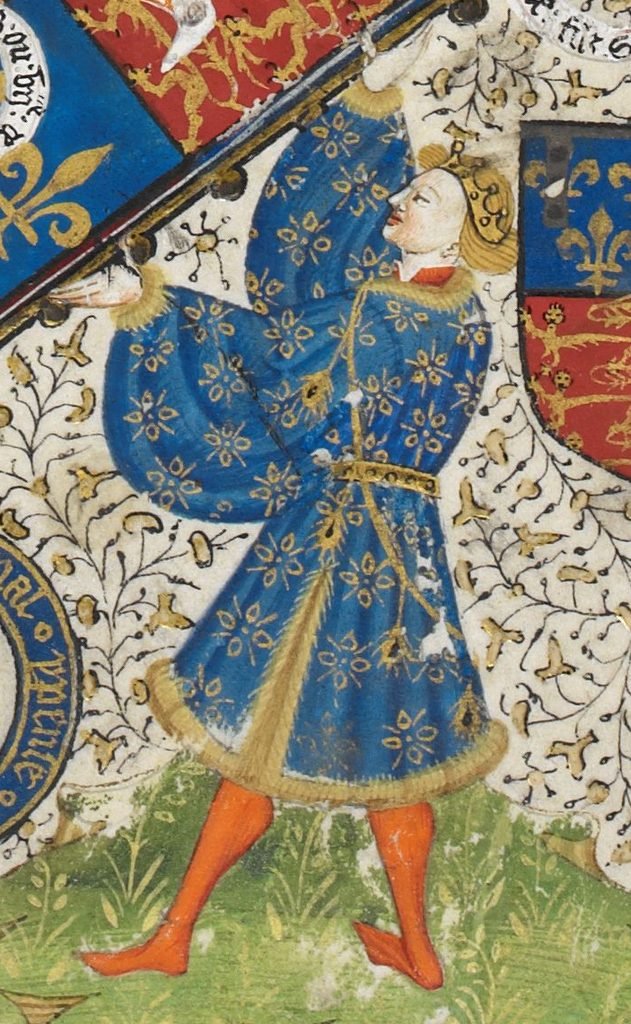
Richard Plantagenet, 3rd Duke of York (1411-1460). Detail from the Talbot Shrewsbury Book, attributed to the Talbot Master, c. 1443-1445. British Library, Royal MS 15 E VI, fol. 2v. Public domain. Image via Wikimedia Commons.
For the young Edward, the months that followed would determine whether his family’s ambitions ended in defeat or culminated in the possession of the English crown. Tall, charismatic, and already demonstrating considerable military ability, he emerged from the turmoil with a determination to succeed where his father had failed, securing an important victory over Lancastrian forces at Mortimer’s Cross in February before advancing towards London. There, with Henry VI’s authority increasingly contested, Edward was proclaimed king in early March, although his possession of the crown remained far from secure while the Lancastrian army continued to resist his claim.
The decisive confrontation came on 29 March 1461, when the armies of York and Lancaster met near the village of Towton in Yorkshire, where bitter winter weather and the ferocity of the fighting combined to produce one of the bloodiest encounters of the Wars of the Roses. Amid driving snow, and brutal hand-to-hand combat, thousands of men were killed as Edward’s forces overcame their opponents, delivering a devastating blow to the Lancastrian cause and forcing Henry VI and his family to seek refuge in Scotland. At just eighteen years old, Edward had achieved what his father had died attempting – securing the throne of England through a victory whose terrible human cost would be felt far beyond the battlefield.
Among those whose lives had already been shattered by the struggle was Elizabeth Woodville, whose husband, Sir John Grey of Groby, had fought for the Lancastrian cause at the Second Battle of St. Alban’s in February 1461. Grey was killed during the fighting, leaving Elizabeth a widow with two young sons at a time when the fortunes of those associated with Lancaster had become increasingly uncertain. Born into a family with connections to the royal court through her mother, Jacquetta of Luxembourg, Elizabeth was no stranger to the world of aristocratic politics, yet the death of her husband placed her in a vulnerable position as the Yorkist victory transformed the political landscape around her.
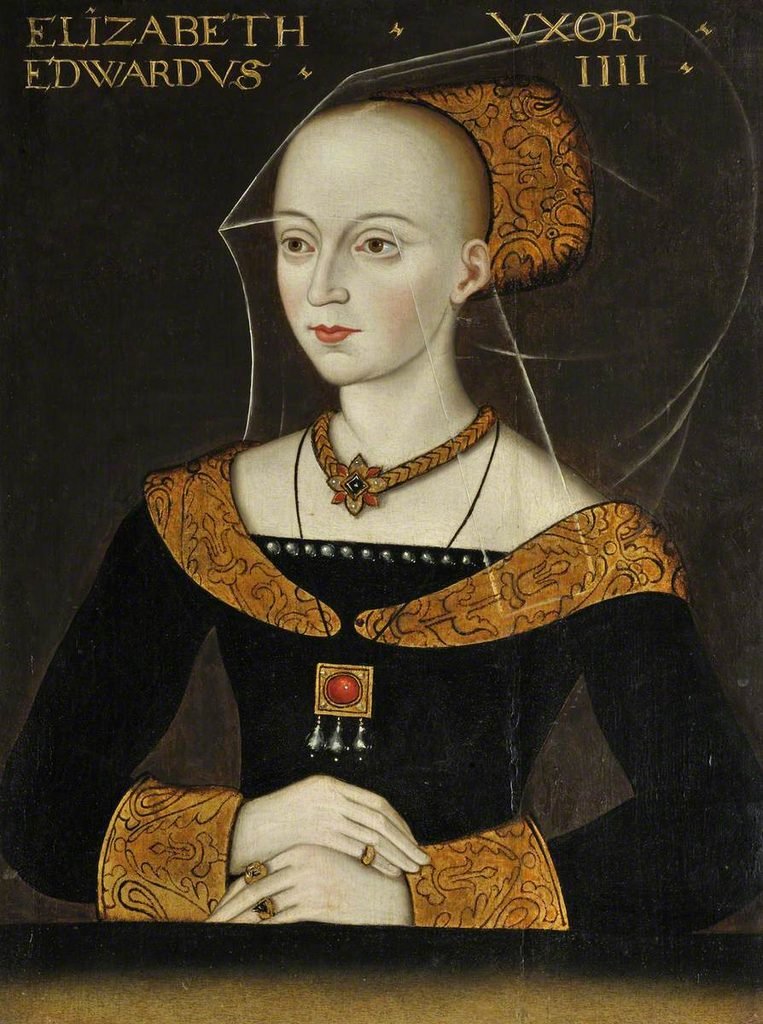
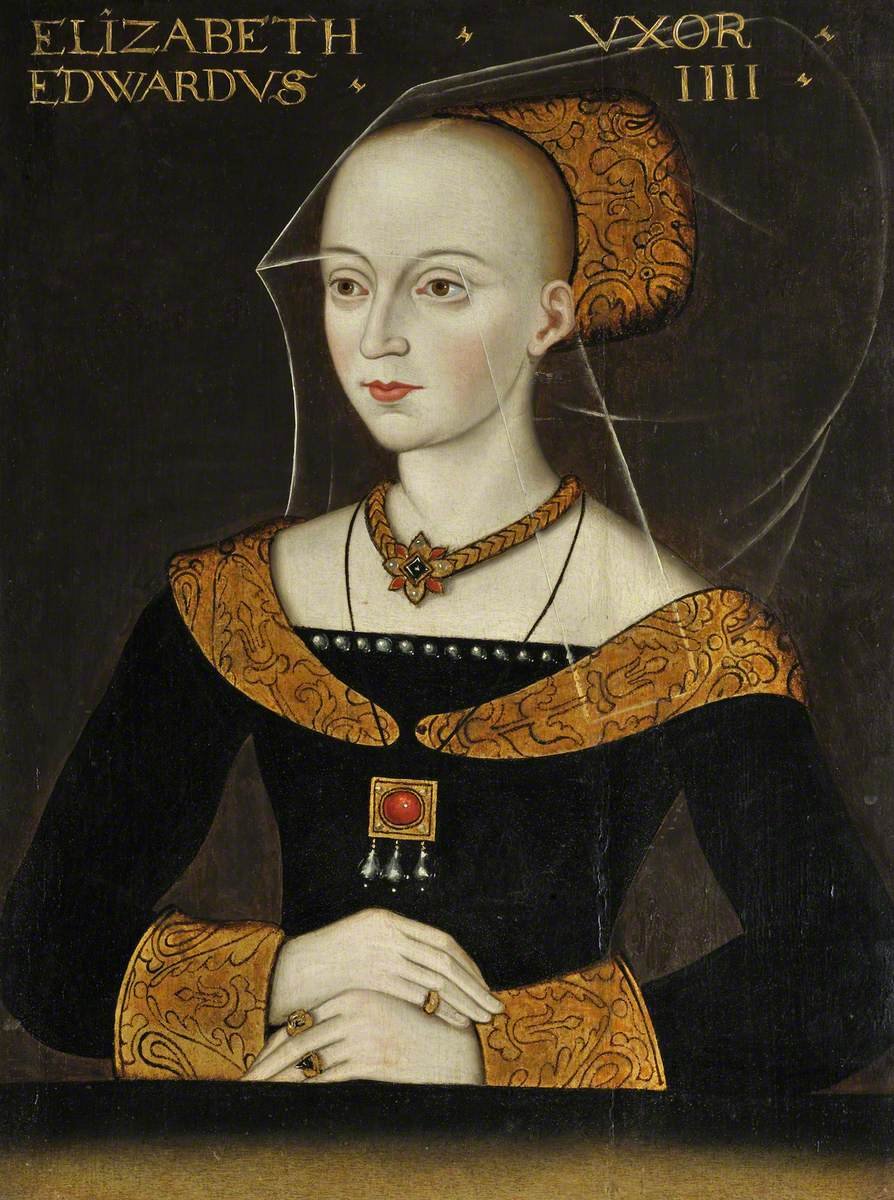
Elizabeth Woodville (c. 1437-1492). Queen Consort of Edward IV. Unknown English artist, after 1500. Queen’s College, University of Cambridge (Portrait 88). Public domain. Image via Wikimedia Commons.
Thus, while Edward IV emerged from the bloodshed of 1461, having succeeded where his father had fallen, Elizabeth faced the uncertain future of a Lancastrian widow in a kingdom now ruled by the enemies of her husband’s cause. Their lives had been shaped by the same violent struggle, although neither could have foreseen that within three years their fortunes would become intertwined in a marriage that would astonish the court and alter the course of English history.
The Paths That Converged
In the years that followed the Yorkist victory at Towton, Edward IV faced the formidable task of transforming military triumph into lasting political authority, for although the Lancastrian cause had suffered a devastating defeat, the struggle for England’s crown was far from over. Henry VI remained alive, his supporters continued to resist the new regime, and the young king was obliged to balance the competing interests of the powerful nobles whose loyalty had helped secure his throne. Yet amid the uncertainties of his reign, one matter remained unresolved, carrying implications not only for Edward’s political future but for the survival of the dynasty he hoped to establish: the King of England had yet to take a wife.
Still in his early twenties, Edward possessed many of the qualities expected to make him an attractive prospect in the marriage negotiations of Europe’s royal courts. His commanding appearance, military reputation, and newly acquired crown offered considerable advantages, while marriage to a foreign princess promised the possibility of valuable diplomatic support for a monarchy still seeking to consolidate its position. For those who viewed royal marriage as an instrument of political strategy, the choice of Edward’s bride was a matter of national importance, one that ought to be determined by the interests of the crown rather than the personal inclinations of the man who wore it.
Meanwhile, Elizabeth Woodville’s circumstances had been shaped by a very different struggle. The death of Sir John Grey had left her responsible for two young sons, Thomas and Richard, while the collapse of Lancastrian fortunes had transformed the political world in which her family had once moved. Yet Elizabeth was far from an obscure widow without connections or influence, for her father, Richard Woodville, had risen through royal service, while her mother, Jacquetta of Luxembourg, had once been married to John, Duke of Bedford, brother of Henry V. Through Jacquetta, Elizabeth possessed connections to the highest ranks of European aristocracy, although such distinguished ancestry could not erase the political complications created by her first husband’s allegiance to Lancaster.
By 1464, the paths of the young Yorkist king and the Lancastrian widow were approaching a remarkable intersection, although precisely how their acquaintance began remains one of the more elusive details of their story. Later tradition would transform their meeting into a scene of almost legendary romance, placing Elizabeth beneath an oak tree as she sought Edward’s assistance in recovering lands associated with her late husband’s family. Accompanied in some versions by her two young sons, she is said to have captured the king’s attention through a combination of beauty, determination, and a refusal to accept anything less than marriage.
It is an irresistible story, possessing all the ingredients of a medieval romance, yet the surviving evidence does not allow us to reconstruct their first encounter with such certainty. The familiar image of Elizabeth waiting beneath the oak tree belongs to a tradition embellished over time, while the circumstances that first drew Edward to her remain uncertain. What is beyond doubt, however, is that by spring of 1464, the young king had formed an attachment to a woman whose background, previous marriage, and family connections made her an unexpected choice for the English throne.
For a monarch whose marriage might have secured an alliance with one of Europe’s ruling houses, the decision to pursue Elizabeth represented a striking departure from political expectations. Whether Edward was motivated principally by affection, attraction, or considerations that have escaped the historical record, his determination to marry her would soon transform what might otherwise have remained a private relationship into a matter of extraordinary dynastic significance. The consequences, however, were still concealed from the court, for before England’s political establishment could fully appreciate what was unfolding, Edward would take a step from which there could be no easy retreat.
The Secret Marriage
In the spring of 1464, while England’s political establishment continued to regard the marriage of Edward IV as a question of diplomacy and dynastic advantage, the young king was preparing to make a decision that would overturn those expectations. Whatever had first drawn him to Elizabeth Woodville, his attachment had developed into a determination to make her his wife, despite the considerable difference between the marriage his advisers might have envisioned and the one he intended to pursue. For a king whose crown had been secured through years of civil war, the choice was extraordinary, not simply because Elizabeth was an English widow with Lancastrian connections, but because Edward appeared willing to settle a matter of immense political importance without the knowledge of those who expected to influence it.
According to the traditional account, Edward and Elizabeth were married on 1 May 1464 at Grafton in Northamptonshire, where her family maintained a residence. The ceremony was conducted in secrecy, far removed from the magnificent public celebrations that might ordinarily have accompanied the marriage of a reigning monarch. Writing decades later, the chronicler Robert Fabyan described a private wedding attended by Elizabeth’s mother, Jacquetta of Luxembourg, and a small number of witnesses, offering a glimpse of an occasion whose apparent simplicity stood in remarkable contrast to the significance of what had taken place.1 Although the precise date and circumstances cannot be established beyond doubt, the marriage itself was real, and its concealment would soon become one of the most consequential features of Edward’s reign.
For Elizabeth, the marriage represented an astonishing transformation in fortune. Only three years earlier, she had been the widow of a Lancastrian knight killed in battle, responsible for two young sons in a kingdom whose political loyalties had been violently overturned. Now, through a union known to only a select few, she had become the wife of the very king whose victory had helped bring about the defeat of her first husband’s cause. Yet the extraordinary elevation of her position remained hidden, leaving her without public recognition, ceremonial standing, or an established placed at court that would ordinarily have accompanied the status of an English queen.
For Edward, meanwhile, the consequences of his decision extended far beyond the personal satisfaction of marrying the woman he had chosen. A royal marriage was expected to strengthen alliances, secure the succession, and reinforce the authority of the crown, particularly for a dynasty whose hold upon England remained contested. By marrying Elizabeth privately, Edward had removed one of the most valuable instruments of royal diplomacy from consideration, while simultaneously creating the possibility that her family would acquire influence at court that established noble houses had neither anticipated nor welcomed.
Yet for several months, the marriage remained concealed from the wider public establishment. While Edward continued to govern a kingdom still troubled by Lancastrian resistance, the question of his future bride remained a matter of expectation among those unaware that the king had already taken a wife. The contrast was remarkable: a decision capable of reshaping the balance of influence within the Yorkist court had been made in private, while the men whose political calculations depended upon it continued to look towards a marriage that could no longer take place.
By the autumn of 1464, however, the secrecy surrounding Edward’s marriage could no longer be maintained. What had begun as a private union between a young king and a widowed gentlewoman was about to become a public declaration, forcing England’s political establishment to confront a reality for which few had been prepared. Elizabeth Woodville would no longer remain the king’s concealed bride, and the consequences of her unexpected elevation were only beginning to unfold.
The Secret Revealed
By September 1464, the secret that Edward IV had guarded for several months was approaching its inevitable revelation, and the consequences of his unexpected marriage were about to extend far beyond the private circumstances in which it had taken place. For those who continued to regard the king’s choice of bride as an unresolved question of diplomacy, the discovery that Edward had already married an English widow would come as an astonishing development, overturning expectations that a royal union might strengthen England’s position through an alliance with a foreign power.
Among those most deeply affected was Richard Neville, Earl of Warwick, whose influence had been instrumental in Edward’s rise to the throne. Known to later generations as the Kingmaker, Warwick had helped secure the Yorkist victory and remained one of the most powerful figures in the kingdom, with considerable expectations of influence over the young king’s government. The possibility of a French marriage had formed part of the diplomatic discussions surrounding Edward’s future, and the revelation that the king had secretly taken a wife threatened to undermine the political calculations upon which such negotiations depended. Although later accounts would portray Warwick as humiliated by the discovery, the precise circumstances of his reaction remain uncertain, and the deterioration of his relationship with Edward would develop over several years rather than emerge from this single decision.
For Elizabeth, meanwhile, the ending of the secrecy surrounding her marriage marked the beginning of an entirely new existence. On 29 September 1464, she was formally presented as Edward’s wife at Reading, bringing into public view a woman whose position had changed beyond recognition since the death of her first husband. Among those who participated in her formal presentation were the Earl of Warwick, and Edward’s younger brother, George, Duke of Clarence, 2 men who would later turn against the king in a struggle that would threaten the very dynasty they had helped establish. Their presence offered a striking contrast to the political divisions that would eventually emerge, as the widow of a Lancastrian knight was now acknowledged as Queen of England, an elevation that placed her at the center of a court where lineage, patronage, and political allegiance could determine the fortunes of entire families.
Yet Elizabeth’s arrival was not simply a personal triumph. Her marriage brought the Woodville family into the orbit of royal power, creating opportunities for advancement that would increasingly unsettle members of the established nobility. Her father, Richard Woodville, and her brothers and sisters would become connected to a network of marriages, offices, and honors that strengthened the family position within the Yorkist establishment. To those who regarded royal favor as a limited and fiercely contested resource, the emergence of a new family with direct access to the king carried implication that extended well beyond the identity of his bride.
Edward, however, had demonstrated that he was prepared to exercise the authority of kingship according to his own judgement, even when doing so frustrated the expectations of those who had helped him obtain his crown. His marriage to Elizabeth revealed a determination to make decisions independently of the powerful men surrounding him, a quality that would increasingly shape the political tensions of his reign. What had begun as an unexpected royal union was becoming part of a wider struggle over influence, loyalty, and the limits of aristocratic power.
The full consequences of Edward’s decision were still to unfold. In the years ahead, Elizabeth would be crowned queen, the Woodvilles would rise to remarkable prominence, and the fragile alliances sustaining the Yorkist monarchy would face renewed strain. The marriage that had once been concealed from the court had now become impossible to ignore, and its influence upon the fortunes of the House of York was only beginning to emerge.
A Crown Divided
The extraordinary circumstances of Elizabeth Woodville’s marriage had brought her to the English throne, but her public recognition in September 1464 marked only the beginning of a transformation that would reshape the Yorkist court. On 26 May 1465, Elizabeth was crowned queen at Westminster Abbey, her elevation celebrated with the splendor and ceremony befitting the wife of a reigning monarch. For a woman who had entered widowhood amid the devastation of civil war, the coronation represented a remarkable reversal of fortune, placing her at the center of a royal household whose influence extended across the political and social life of the kingdom.
Yet the rise of Elizabeth’s family would prove considerably more contentious than the celebrations surrounding her coronation might have suggested. Her father, Richard Woodville, was elevated to Earl Rivers in 1466, while marriages arranged for her many siblings connected the family to some of England’s most powerful aristocratic houses. Such advancement was not unusual for the relatives of a queen, but the speed and scale of the Woodvilles’ growing influence intensified competition for royal favor, particularly among those who had long regarded themselves as indispensable to Edward’s government. Warwick, whose authority had once seemed almost inseparable from the Yorkist cause, increasingly found himself at odds with a king determined to exercise greater independence over matters of patronage and foreign policy.
By 1469, the tensions that had developed within Edward’s circle erupted into open rebellion. Warwick joined forces with George, Duke of Clarence, whose marriage to Warwick’s daughter, Isabel Neville, strengthen their political alliance. Together they challenged the king they had once supported. The conflict culminated in the Battle of Edgcote in July, where royal forces were defeated and Edward briefly fell into Warwick’s custody. In the aftermath, Elizabeth’s father and brother, John Woodville, were captured and executed, demonstrating with brutal clarity how swiftly the fortunes of a family raised by royal favor could be destroyed by political upheaval.
The struggle for control of the kingdom continued, drawing England once more into the violence of dynastic warfare. Warwick eventually abandoned Edward and allied himself with the Lancastrian cause, helping restore Henry VI to the throne in 1470 and forcing Edward into exile. Elizabeth, pregnant and facing the collapse of her husband’s government, sought sanctuary at Westminster Abbey, where she gave birth to their son, the future Edward V, in November. The woman whose marriage had once astonished the Yorkist court now found herself sheltering from the consequences of a conflict that threatened to extinguish the dynasty into which she had married.
Edward’s return in 1471 brought another dramatic reversal. With support from Burgundy, he reclaimed his throne, defeated Warwick at the Battle of Barnet, and overcame the Lancastrian army at Tewkesbury, restoring Yorkist authority after months of uncertainty. For the following decade, Edward and Elizabeth presided over a court that appeared increasingly secure, their marriage producing a growing royal family and the long-awaited prospect of a stable succession. Yet beneath that apparent stability lay political divisions that had never entirely disappeared, and the survival of the dynasty remained dependent upon the authority of the king who had established it.
When Edward IV died unexpectedly on 9 April 1483, the consequences of his marriage would become entangled in a succession crisis more devastating than either he or Elizabeth could have anticipated. Their eldest surviving son, Edward V, was only twelve years old, and the struggle for control of the young king brought the Woodvilles into direct conflict with Edward’s youngest brother, Richard, Duke of Gloucester. Within weeks, Elizabeth’s brother Anthony Woodville, Earl Rivers, and her son from her first marriage, Richard Grey, were arrested and subsequently executed, while Elizabeth once again sought sanctuary at Westminster with her younger children.
The crisis reached its decisive moment in June 1483, when the legitimacy of Edward IV’s marriage to Elizabeth was publicly challenged on the grounds of an alleged earlier contract between Edward and Eleanor Butler. The claim, which remains historically disputed, provided the basis for declaring Edward and Elizabeth’s children illegitimate and excluding them from the succession. Richard, Duke of Gloucester, took the crown as Richard III, while Edward V and his younger brother, Richard, disappeared from public view after being lodged in the Tower of London, leaving their ultimate fate one of the most enduring mysteries of English history.
The marriage that had once elevated Elizabeth Woodville to the throne had become the very foundation upon which her children’s claim to that throne was contested. Yet the story of Edward and Elizabeth’s extraordinary union did not end with the collapse of their sons’ prospects, for through their eldest daughter, Elizabeth of York, the marriage would acquire a significance extending far beyond the fate of the House of York itself.
The Marriage That Changed a Kingdom
In the aftermath of Richard III’s accession, the future of Edward IV’s surviving children remained uncertain, their claims to the throne undermined by the declaration that their parents’ marriage had been invalid. Yet among those whose fortunes had been transformed by the upheaval was Elizabeth of York, the eldest daughter of Edward and Elizabeth Woodville, whose position would become central to the political ambitions of a man preparing to challenge Richard’s rule. Henry Tudor, the Lancastrian claimant who had spent much of his life in exile, offered the possibility of a new political settlement through marriage to the Yorkist princess, whose bloodline connected him to the dynasty he sought to replace.
The prospect of their union acquired particular significance as opposition to Richard III gathered strength. Henry pledged to marry Elizabeth of York in December 1483, presenting their future marriage as a means of reconciling the rival dynastic interests that had divided England for decades. When Richard was defeated and killed at the Battle of Bosworth on 22 August 1485, Henry claimed the crown as Henry VII, establishing his authority independently of Elizabeth’s hereditary claim, although his marriage to Edward IV’s daughter would strengthen the legitimacy of his new dynasty. Their wedding took place on 18 January 1486 at Westminster Abbey, bringing together the surviving claims and political interests of the Houses of Lancaster and York in a union that would become one of the defining symbols of Tudor kingship.
For Elizabeth Woodville, who had endured widowhood, political rebellion, sanctuary, and the disappearance of her two youngest sons, the marriage of her daughter to the new king represented another extraordinary reversal in a life repeatedly shaped by the struggle for England’s crown. Although the fate of Edward V and Richard, Duke of York, remain unresolved, Elizabeth lived to witness the establishment of the Tudor dynasty and the birth of her grandsons -Arthur in 1486 and the future Henry VIII in 1491. When she died in June 1492, the woman whose secret marriage had once astonished the Yorkist court had become the maternal grandmother of a new generation of English royalty.
The consequences of Edward IV’s decision in the spring of 1494 had therefore extended far beyond the expectations of those who first learned of his marriage. What had begun as a private union, undertaken without the political arrangements traditionally associated with royal matrimony, had helped shape the fortunes of two dynasties and provided a vital connection between the Yorkist monarchy and the Tudor succession. Yet the marriage itself cannot be reduced to the political conflicts that followed, for the choices of those who opposed Edward, the ambitions of rival claimants, and the uncertainties of civil war all played their part in determining the kingdom’s future.
More than two decades after Edward and Elizabeth were secretly married, their eldest daughter became Queen of England beside Henry VII, carrying the legacy of the House of York into the dynasty that would succeed it. The young king who had once defied the expectations of his court could scarcely have imagined the extraordinary path his decision would follow, from a private ceremony in Northamptonshire to the upheavals of rebellion, deposition, and dynastic reconciliation. In seeking a wife beyond the calculations of his advisers, Edward IV had made a choice whose consequences would outlive him, binding the fate of Elizabeth Woodville and her descendants to the future of the English crown.
The marriage that had astonished a kingdom would ultimately help shape the dynasty that inherited it.
Sources
- Fabyan, Robert. The New Chronicles of England and France, in Two Parts. Edited by Henry Ellis. London: F.C. and J. Rivington, 1811. Reprinted from the 1516 edition. Available at https://archive.org/details/newchroniclesofe00fabyuoft/page/n29/mode/2up
- Chamberlayne, Joanna L. (1999). English Queenship, 1445-1503. PhD thesis, University of York. Available at https://etheses.whiterose.ac.uk/id/eprint/9789/1/301684.pdf
Further Reading
- Amin, Nathen. Son of Prophecy: The Rise of Henry Tudor (2024).
- Baldwin, David. Elizabeth Woodville: Mother of the Princes in the Tower (2002).
- Higginbotham, Susan. The Woodvilles: The Wars of the Roses and England’s Most Infamous Family (2013).
- Jones, Dan. The Wars of the Roses: The Fall of the Plantagenets and the Rise of the Tudors (2014).
- Laynesmith, J. L. The Last Medieval Queens: English Queenship 1445-1503 (2004).