
The first question we should ask ourselves is, what is a saint? The answer may vary depending on the perspective from which we approach the subject. Over the centuries, Eastern and Western Christianity developed different understandings of sanctification, particularly following the debates surrounding Hesychasm in the fourteenth-century Byzantine Empire, in which Saint Gregory Palamas emerged as one of the most influential theologians on the subject.
The very idea of a saintly emperor, king, queen, or even politician may still seem unusual in the West. For the Orthodox Church, however, particularly during the Byzantine period, this was the ideal that the faithful expected their rulers to embody. Orthodoxy and philanthropia were essential virtues of a true Eastern Roman emperor.
What, then, is a saint?
The Orthodox tradition has come to understand a saint as someone who has cooperated with God’s grace throughout their life. The cooperation between the human will and the will of God is known as synergy. Beyond the broader use of the word saint to refer to all members of the Church, Holy Tradition also bestows this title upon particular individuals whose lives have demonstrated more clearly what it means to follow Christ. These saints are glorified by the Church through popular acclamation. Today, this process usually involves a formal service that recognizes and affirms the faithful’s veneration of them.
And here comes another question… If emperors were expected to rule with authority, punish their subjects, wage wars, or, in some cases, had even been responsible for the deaths of others, how could they possibly be saints?
Perhaps the answer lies in the Orthodox emphasis on Theosis, understood as the process by which Christians become partakers of God’s “Uncreated Energies”, manifested through the “Uncreated Light”. Hesychast monks refer to this as the “Light of Tabor”, revealed to the disciples during the Transfiguration.
In this way, the saints in the Heavenly Kingdom are not merely with God, but also in God, united with His energies, though not with His essence. This is a process that begins in this life and continues day by day, as the divine energies work within the human person.
It was never simply a matter of perfection, but rather of an openness of heart. The Byzantine Empire offers a clear example of how, in the eyes of the faithful, Christian piety could outweigh an emperor’s human shortcomings. The following nine cases offer some testimony to this tradition.
I. Constantine the Great (r. 306–337)
Known as “the first Christian emperor”, Constantine is famous for reunifying the Roman Empire under his rule following the collapse of the Tetrarchy. Writers such as Eusebius of Caesarea and Lactantius attributed his victory over Maxentius at the Battle of the Milvian Bridge in 312 to divine intervention. In hoc signo vinces is a phrase that remains inseparable from Constantine’s legacy.
Following his victory, his popularity among Christians grew considerably. He brought an end to the persecutions, issued the famous Edict of Milan in 313, which not only guaranteed religious toleration but also ordered the restitution of property to Christian communities, and convened the First Ecumenical Council of the Church at Nicaea in 325, where Arianism was condemned.
He also authorized the construction of the Church of the Holy Sepulchre in Jerusalem and, in 330, transferred the imperial capital to Constantinople, which would remain the most important city in the Christian world for centuries.
All these achievements earned him great esteem among the faithful. For this reason, he is venerated by the Orthodox Church alongside his mother, Saint Helena, every year on May 21.
II. Theodosius the Great (r. 379–395)
Known as a deeply devout Christian, Theodosius enacted laws that dealt a decisive blow to paganism within the Empire. He also issued the famous Edict of Thessalonica in 380, making Nicene Christianity the official faith of the Roman Empire and taking action against various heretical movements.
Another major achievement was his convocation of the Second Ecumenical Council at Constantinople in 381, where Apollinarianism and Macedonianism were condemned, and the condemnation of Arianism was reaffirmed. This was also the council at which the well-known “Symbol of Faith”, or Niceno-Constantinopolitan Creed, was formulated.
The legacy he left behind, at least among Christians, earned him a place in the Orthodox Church’s calendar of saints, where he is commemorated on January 17.
III. Theodosius II the Younger (r. 408–450)
The son of Emperor Arcadius and grandson of the aforementioned Theodosius the Great, he ascended to the throne as a child, growing up under the influence of his elder sister, the devout Saint Pulcheria. In addition to waging conflicts against the Persians and Huns and overseeing the publication of the Codex Theodosianus, his reign was also marked by hostility towards pagans and heretical movements.
In 431, he convened the Third Ecumenical Council, which met at Ephesus and condemned Nestorianism, affirming the Virgin Mary’s title as the Mother of God — Theotokos.
The Orthodox Church commemorates him on July 29.
IV. Leo I the Thracian (r. 457–474)
He was the first emperor to receive the imperial diadem from the hands of the Patriarch of Constantinople, giving the coronation ceremony a distinctly religious character. He supported the Chalcedonian Church, helped remove the Monophysite Patriarch of Antioch, Peter the Fuller, and in 465 decreed that only Orthodox Christians could serve in the fiscal administration and judicial services. He also ordered that no work or commercial activity should take place on Sundays.
In 473, he brought the relic of the Virgin Mary’s robe from Palestine to Constantinople, where it was deposited in the Church of Saint Mary of Blachernae.
Let us not be put off by his nickname, Makellēs (meaning “the Butcher”). This emperor is commemorated by the Orthodox Church on January 20.
V. Justinian I the Great (r. 527–565)
Perhaps the most famous of all Byzantine emperors, Justinian’s reign witnessed remarkable developments in culture, religion, law, the arts, and military strategy. It was also marked by his famous Renovatio Imperii, a grand campaign aimed at recovering the territories once held by Rome in the West.
During his reign, several churches were built, most notably the Monastery of Saint Catherine on Mount Sinai and the magnificent Basilica of Hagia Sophia in Constantinople. He is also remembered for promoting the idea of Symphonia between Church and State.
Justinian left his mark on the history of the Ecumenical Councils by convening the Fifth Ecumenical Council at Constantinople in 553. The council sought to condemn the Three Chapters — the writings associated with the Nestorian tradition by Theodore of Mopsuestia, Ibas of Edessa, and Theodoret of Cyrrhus — as well as the teachings of Origenism.
The Orthodox Church commemorates him on November 14, alongside his wife, Empress Theodora.
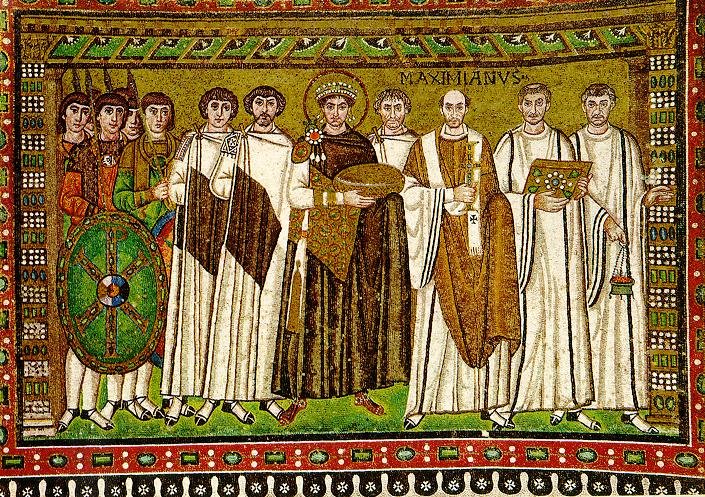
Justinian’s Mosaic. Church of St. Vitale, Ravenna, Italy, 6th century. Wikimedia Commons
VI. Maurice (r. 582–602)
The last representative of the Justinianic dynasty, Maurice secured a lasting peace with Persia by helping Khosrow II regain his throne. He also faced the threat posed by the Avars and Slavs in the Balkans and is traditionally regarded as the author of the famous military manual, the Strategikon.
This emperor established August 15 as the feast day of the Dormition of the Mother of God. However, the episode for which he is most remembered by the Church came at the very end of his reign.
Financial difficulties and a lack of resources led to widespread unrest, and in 602, the Balkan army, led by Phocas, marched on Constantinople. Captured by the rebels, Maurice accepted his impending death with remarkable serenity. Phocas forced him to witness the beheading of his six sons before finally putting him to death.
The Church would later recognize his patience and Christ-like serenity in the face of suffering. For this reason, he is commemorated on November 28.
VII. Nikephoros II Phokas (r. 963–969)
This distinguished general became emperor and regent for the young Basil II. He was particularly known for his ascetic way of life, and it was said that he wore monastic garments beneath his imperial robes.
During his campaigns against the Muslims, he earned the nickname “The Pale Death of the Saracens”. In 960, he led a major nine-month siege of Chandax on the island of Crete. The following year, he captured the city and recovered the entire island from Muslim rule.
Meanwhile, in 958, the monk Saint Athanasius the Athonite arrived on Mount Athos, and in 962, the first church was built at Karyes. In 963, it was Nikephoros himself who provided him with land and resources to establish the Great Lavra Monastery, the first monastic foundation on Mount Athos.
In 969, he was betrayed by his wife Theophano, who conspired with John I Tzimiskes to have him murdered in his own bedchamber, before the holy icons. Tzimiskes subsequently seized power and became the new emperor.
The Orthodox Church commemorates Nikephoros II on December 11.
VIII. John III Doukas Vatatzes “the Merciful” (r. 1222–1254)
John III ruled the Empire of Nicaea in the aftermath of the Fourth Crusade, when the Byzantine Empire had been temporarily fragmented following the Crusaders’ invasion and the establishment of the Latin Empire. His personal virtues made him a trusted figure in the eyes of Emperor Theodore I Laskaris, who gave him his daughter Irene in marriage.
During his reign, the so-called Empire of Nicaea experienced remarkable cultural, economic, and military growth, which eventually led to the recovery of extensive territories. His commitment to justice and the protection of the most vulnerable earned him the epithet “the Merciful”.
John was an emperor deeply devoted to the Christian faith. He built and restored churches while remaining equally committed to the restoration of the Empire. By the end of his reign, the Byzantine Empire was already close to being restored, a process that would finally be completed in 1261 with the recovery of Constantinople.
He is commemorated by the Orthodox Church on November 4.
IX. Manuel II Palaiologos (r. 1391–1425)
The son of Emperor John V, Manuel II was also the father of the last two Byzantine emperors, John VIII and Constantine XI. Although he was not the eldest son, his father chose him as his successor after Manuel had helped him confront the rebellion of his elder brother and nephew. He had also previously come to his father’s aid by securing his release from the imprisonment imposed by the Venetians.
For a long time, both Manuel and his father were forced to seek the assistance of the Ottoman Sultan Murad I, submitting to humiliating terms in order to put an end to the threats against them. In the years that followed, the Turks, who were also well aware of the divisions within the imperial family, continued conquering significant portions of the Balkans.
In 1396, Manuel travelled to Western Europe in search of military assistance against the Turks. His journey took him to Rome, Milan, London, and Paris, where he established closer ties with their respective rulers. However, the promised assistance never materialized.
A man deeply interested in literature and intellectual pursuits, Manuel wrote a ‘Mirror for Princes’, as well as several theological works. He also warned his son not to abandon the truths of the Orthodox faith in negotiations with the Papacy, nor to rely on Western assistance as a means of avoiding direct confrontation with the Turks.
The Orthodox Church commemorates him on July 21.
The possibility of emperors and politicians being recognized as saints may seem paradoxical from a modern perspective. However, it is important to emphasize the message that has been conveyed over the centuries: the higher a man’s or woman’s position in this world, the greater the responsibility they bear before God.
Although they were sinners and, at times, committed reprehensible acts, emperors too underwent their own process of Theosis, and some eventually came to be recognized as saints.
Perhaps our politicians today do not inspire us to embrace this ideal, but in the Byzantine Empire, holiness was understood as a universal calling, one that extended from the poorest man in the Empire to the Emperor of the Romans himself.
Peter Sarris’s biography of Justinian published some time ago under the title Justinian: Emperor, Soldier, Saint, has renewed interest in exploring the religious dimension of imperial rule. It presents emperors as more human figures, driven by emotions and guided by a Christian agenda without which their actions and achievements cannot be fully understood.
Bibliography
The Synaxarion: The Lives of the Saints of the Orthodox Church, 7 vols. (Convent of the Annunciation of Our Lady, Ormylia, 1998).
Peter Sarris, Justinian: Emperor, Soldier, Saint (Basic Books, 2024).
Eusebius of Caesarea, Life of Constantine, Averil Cameron and Stuart Hall (trans.), (Clarendon Press, 1999).
Timothy Ware, The Orthodox Church: An Introduction to Eastern Christianity (Penguin Books, 1997).

