
1066 A.D. The most notorious year in English history, and perhaps the most consequential in the entire history of the West. In the years leading up to the now legendary Norman conquest of England by William the Conqueror, Duke of Normandy, a lesser-known and altogether more drawn-out Norman conquest was unfolding 1000 miles away. The Norman conquest of Sicily, which spanned the decades between 1060 and 1091 A.D., was spearheaded by the two most famous brothers of the Hauteville dynasty, a family of minor knights from Normandy whose exploits in South Italy as bandits, mercenaries, and eventual rulers are worth returning to at length another day.
Robert de Hauteville, nicknamed “le Guiscard” – the cunning – and his younger brother Roger had spent most of the decade leading up to 1062 A.D. suppressing revolt after revolt from landowners and local governors in Apulia and Calabria aiming to shake off Norman authority. Although Guiscard officially became Duke of Apulia and Count of Calabria and Sicily by the order of Pope Leo IX following a crushing Norman victory at the Battle of Civitate in 1053 A.D., more than a few local families resented the Hautevilles for their meteoric rise to power. Many competing families considered them parvenues whose comparatively nascent presence on the Italian peninsula ought to mean they should yield to the better-established families in the mezzogiorno. Others, like local Greek and Lombard populations, were subject to violent raids on their towns and farms which often included torched crops, butchered animals, and dead farmers. After a half-century or more of rampant incursions on their lands by the Hautevilles and others, local leaders had good reason to detest the Norman presence on the peninsula – even while being usurped by it.
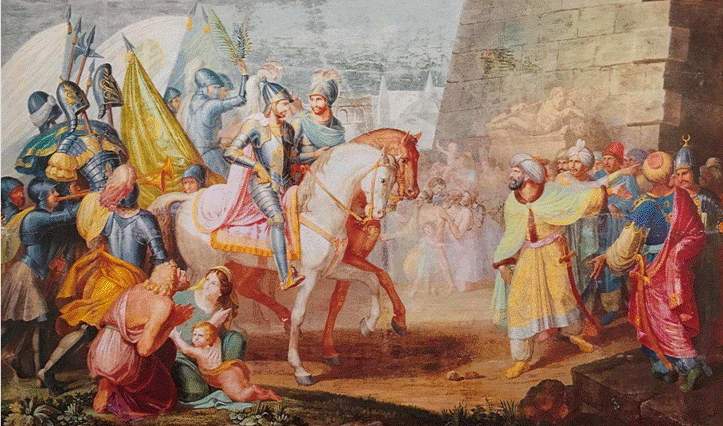
Giovanni Patricolo, 1835 – L’ingresso di Roberto il Guiscardo e del conte Ruggero a Palermo (The Entrance of Robert Guiscard and the Count Roger at Palermo) via Wikimedia Commons
The trouble with Troina
The growing tension in the mezzogiorno inevitably contributed to regular clashes with the local nobility and, indeed, each other. A particularly melodramatic episode unfolded at Gerace in 1062 A.D., after months of argument between the Hauteville brothers over how they would divide the spoils of their recent conquests in Calabria. After months of tension, including a siege upon Mileto by the wrathful Guiscard wherein he was held captive by the local garrison, the knightly Norman pair settled their differences with a tear-soaked embrace. Medieval chronicler and Benedictine monk Geoffrey Malaterra, who found himself in Roger’s employ, described the scene in nothing less than biblical terms: “When the duke and count saw each other – as once Joseph and Benjamin – a sight they had hoped for but not expected, until fortune had turned to the better, they burst into tears and eagerly embraced each other”. Whether the melodrama of this moment was faithfully reported or, perhaps more likely, zealously embellished is left for the modern reader to wonder.
Following this reconciliation of biblical proportions, Roger returned to the matter freshly at hand: wresting the island of Sicily from the various fractured Kalbid factions in power there. In midsummer 1062, Roger returned to Troina, a little town in the Nebrodi mountains populated mostly with Greek Christians, with his wife and an army about three hundred strong. The sympathies and hospitality of Troina’s largely Christian populace had allowed Roger to establish a permanent garrison there the previous summer, ousting the local Muslim lords. In the ensuing year, however, those sympathies had seemed to evaporate, due in no small part to the barbaric behaviour of the Norman warriors who had settled there in the meantime. Popular historian and travel writer John Julius Norwich describes the mood below, making reference to the local Muslim population as“Saracens,”an epithet common in the High Middle Ages:
As so many of their compatriots and co-religionists were to find during the early years of Norman domination, their new masters were often worse than the old. They were more demanding than the Saracens, tougher and more unscrupulous in getting what they wanted. Even their Christianity was incomprehensible, crude in its practices, barbaric in its language; and their free and easy ways with the local women were already notorious throughout the island. The Troians had suffered particularly in this last respect.
Little wonder, then, that the local population would be prepared to seize any opportunity to rid themselves of their Norman overlords. This opportunity came in the summer of 1062 when Roger and his soldiers departed to besiege the neighbouring town of Nicosia, leaving his wife, Judith, behind. The townsfolk saw their chance and snatched it, kidnapping and holding Judith hostage before sending word to the count that his wife was in captivity. Furious, Roger galloped back to Troina to rescue his beloved, but found to his dismay that several thousand of the local Muslim population had flooded into the city, joining forces with the Troians in an attempt to oust the Normans once and for all. He’d fallen perfectly into the trap. Roger “at once ordered a general retreat to the few streets immediately surrounding the citadel”, hunkering down behind slipshod, hastily constructed battlements.
The Lion in Winter
The younger Hauteville brother could have had little concept of what he was about to endure. Under nearly constant siege from the local population, severely undersupplied – the Normans could not have been expecting a protracted engagement – and the weather growing ever colder, Roger and his small contingent endured a months-long descent into one of the coldest winters in recorded Sicilian history. Troina, which stands 4000’ above sea level, was regularly blanketed with snow, and his men, malnourished and freezing, grew weaker by the day. As Christmas approached, time was running out.
In January of 1063 A.D., Roger made a critical observation of his captors, who were themselves not impervious to the effects of the winter weather. Although the vast majority of the enemy garrison were Muslim, and thus forbidden by Muhammad to drink alcohol, they had taken to drinking red wine to keep them warm during the coldest nights of the year. Roger noticed that each night, they seemed to drink just a little more wine, and to feel its effects just a little more intensely. A scheme was hatched, and on a cold, dark January night, Roger and his contingent crept silently over the barricades and through the snow to find their captors totally unconscious from drink, “sleeping like children”. The Normans acted quickly, taking enemy positions one silent dagger at a time, until the town was once again in Roger’s hands.
While Malaterra doesn’t go into tremendous detail as to the bloody extent of Roger’s wrath upon the dawning of the next day, it is sufficient to admit that it was terrible; we’re told that, at the very least, the leaders of the resistance effort were immediately hanged. The count’s vengeance, perhaps made all the more gruesome by one’s imagination in the absence of recorded details, seemed to echo the concerns of the Troians with regard to their Norman masters: tough and unscrupulous.
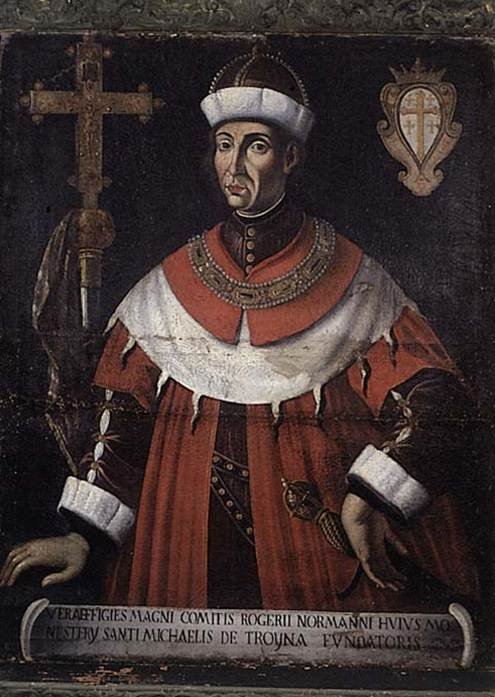
Portrait of Roger I of Sicily, preserved at the Cathedral of Troina (Anonymous, 1609-1648, oil on canvas) via Wikimedia Commons
Are we the baddies?
This tale of wit, daring, and determination seems to perfectly encapsulate the reputation that the Hautevilles wished to have enshrined in the history books. It also raises a fairly common concern when dealing with the Normans; namely, the way their presence must have been experienced by the peoples they conquered. In her fabulous book The Normans, Dr. Judith A. Green is quick to alert her readers that Geoffrey Malaterra, referenced above, and fellow chronicler William of Apulia “were writing for the Hautevilles.” Generally speaking, “enemies of the Hautevilles are shown as disruptive”. This included anyone who may have objected to or resisted the act of conquest they suffered at the hands of the family. The inhabitants of Troina certainly didn’t escape Malaterra’s spiteful pen as the entire Greek population was lambasted by the author as “indeed the most treacherous of people”.
Playing for sympathy was a critical aspect in the work of the Norman chroniclers. Take, for instance, Malaterra’s descriptions of Roger’s forces “cooped up” at Troina while engaged with the local forces. Malaterra paints a pitiful portrait of the count and his wife, who “were so short of clothes that [they] only had one cloak between them”. He goes on to express how seemingly unfair it was that “the Greeks and Saracens, with the whole country supporting them and furnishing what they wanted, were fed in abundance.” Malaterra seems indignant that “all Sicily provided the supplies which they needed”, in spite of the fact that what he’s describing is a communal effort to repel a foreign army of rapacious invaders.
Even in moments where the chroniclers seem to acknowledge the questionable behaviour of the conquerors, the moral fabric of their actions is hardly called into question; indeed, they seem to be chalked up to the everyday reality of their presence on the island. Malaterra laments that the Normans were “unable to seek provisions through plundering raids as was their custom, and as a result they were seriously affected by hunger”. The way Malaterra simply glosses over the Normans’ seemingly customary “plundering raids” to more quickly get to the point is almost comical in its nearsightedness. Imagine the horror, dear reader! That our brave (dare I say heroic?) bands of roving, pillaging conquerors were unable to engage in their typical merciless banditry to provide for themselves is truly gut-wrenching. Let’s spare a moment for these poor defenceless souls.
Writing the Norman Project
The idea that history is written by the victors is not a fresh or a novel one. Those without a voice have long struggled under the yoke of those in power, and that struggle bleeds into eternity in the pages of history. That said, it is still remarkable to examine the great pains Hauteville chroniclers took to portray “the Normans’ victories as those of young heroes over an old and decaying power”, to portray Roger as “someone whose actions brought peace and stability”, and to portray the Norman conquest of Sicily as parallel to the First Crusade: a holy war against the infidel. In short, the Hautevilles were masters of narrative. Crafting an image befitting a ruler is a practice Count Roger of Sicily would one day pass on to his son and eventual heir, Roger II, who would in due course secure a spot for the Hauteville name in the annals of history with the foundation of the Kingdom of Sicily in 1130 A.D. Projecting legitimacy through science, art, literature, and faith would one day become a cornerstone of the younger Roger’s royal policy.
We don’t have even a fraction of the space necessary to discuss the shameless whitewashing, questionable rhetoric, and, at the risk of sounding anachronistic, blatant Islamophobia inherent to medieval European chronicles. But it is enough to remind ourselves as consumers of historical narrative that moods, actions, and opinions are not always as they’re portrayed. Furthermore, it feels incumbent upon the modern reader to recognise that a medieval chronicle, surviving for 1000 years to the present day, is a precipitously thin slice of a broader, fuller reality. Count Roger was not a one-dimensional hero or villain; he lived a full, multifaceted life over the course of his seventy years, which included some truly heroic moments and startlingly modern policy decisions. Keeping this in mind, can we then sit back and enjoy the swashbuckling story of Roger’s victory at Troina? Or do we have a moral duty to take the perspective of the Greek inhabitants who suffered so cruelly at the hands of Roger’s men, barring us from taking any pleasure out of such a daring tale? I don’t have these answers, and if you do, be sure to let me know.
Bibliography
Green, Judith A, The Normans, (Yale University Press, London, 2022).
Malaterra, Geoffrey, Historia Sicula, (Translation by G.A. Loud, University of Leeds).
Norwich, John Julius, The Normans in the South, (Faber & Faber, London, 2018).