The Problem with Calling the Jǫtnar ‘Giants’
Giants are among the best-loved races of fantasy literature, where they are usually portrayed as huge beings of monstrous or menacing appearance. They also appear, under different names, in many of the world’s mythologies. In Norse mythology, the word rendered in Greek as gígantes (γίγαντες), and in English by the related ‘giants’, is jǫtnar (singular jǫtunn).
The question therefore arises whether, in the light of the existing sources, this rendering is a sound one, and whether in the end it helps the reader or leads the reader away from understanding the full nature of these creatures. So let us see what emerges from the mythological material, but also from an exploration of Old Norse lexicography.
The Dictionary of Standard Modern Greek (Λεξικό της Κοινής Νεοελληνικής) defines gígantas (γίγαντας) primarily as someone of unusual height and size. In Greek mythology we have our own Giants, with a specific genealogy and a distinct mythological tradition. The use of a common name, both for our own category of mythological creatures and for the jǫtnar, may create confusion and conceal differences in their nature and function.
An attempt on Etymology
The origin of the word jǫtunn is probably to be traced to *etunaz. The asterisk marks a reconstructed Proto-Germanic form, one that no surviving text preserves, and this form is connected with the verb *etaną, which means ‘to eat’. Old English, or Anglo-Saxon, has the related word eoten, which is used of a giant and, more loosely, of a monster in general. Etymologically, then, the word points to a being that ‘devours’, one with an appetite beyond the ordinary. One might take this hunger as figurative as well as literal and see the jǫtnar as beings who have lost all sense of measure, though here, of course, we have already moved into interpretation.
For a first concrete case from the Scandinavian tradition we may take Vafþrúðnir. In Vafþrúðnismál, a poem of the Poetic Edda, Odin measures himself against him in a contest of wisdom, and the questions concern how the world came into being and what its fate will be. The poem says nothing of any great bodily size, nor does it give him a single monstrous feature. What it stresses is his erudition and his wisdom, which directly rivals that of the father of the gods. If we simply accept the derivation from ‘to devour’, we could just as well, and wrongly, apply the label to the gods themselves, who on occasion devour enormous quantities of food. In Þrymskviða, for instance, Thor devours a whole ox and eight salmon and washes them down with vast quantities of mead.
Gods and Jǫtnar
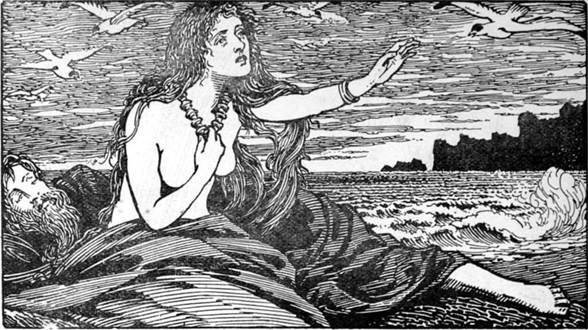
Picture: Skadi’s longing for the Mountains, by W. G. Collingwood, 1908 Wiki Commons
Another case is that of Skaði, whose father Þjazi was a jǫtunn. She becomes the wife of Njǫrðr, a god of the Vanir, after her father’s killing by the gods, which Snorri Sturluson describes in his Prose Edda. She is nowhere described as monstrous in form. The gods accept her into their pantheon and give her particular roles as well, namely those of a goddess of hunting who is connected with the snow-covered mountains. Gerðr, too, the daughter of the jǫtunn Gymir, is a jǫtunn so beautiful that Freyr falls in love with her in Skírnismál, and in order to obtain her he hands over to his messenger, Skírnir, his fearsome sword, the one that fights by itself. This will of course be the omen of his doom, since at Ragnarǫk he will be called upon to face Surtr, who is connected with the forces of fire, without his sword.
It should be made clear at this point that gods and jǫtnar are very closely related, despite being placed in distinct mythological categories, since Odin’s own mother is the jǫtunn Bestla, daughter of Bǫlþorn.
Ymir: A Jǫtunn of Cosmic Proportions
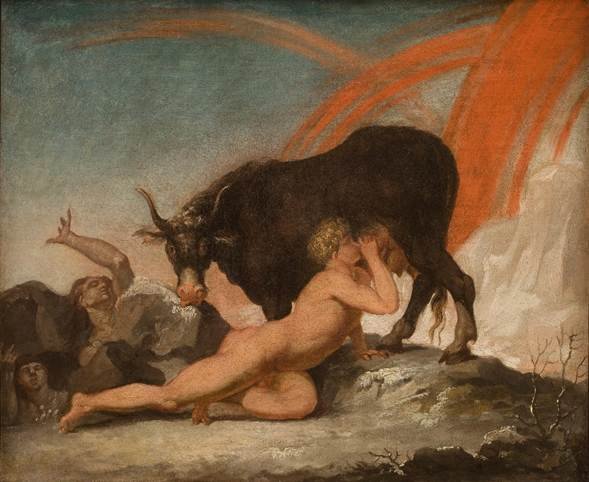
Picture: Audhumla by Abildgaard, by Nicolai Abildgaard, 1777 Wiki Commons
An interesting exception is Ymir, the primordial jǫtunn from whose body the world was made. Vafþrúðnismál calls him a jǫtunn in so many words (stanza 21). Grímnismál (stanzas 40–41) tells what was made from his body. His flesh became the earth and his bones the mountains, the sky was made from his skull, and from other parts of him came further elements of the natural world. He is a figure of truly titanic proportions. In my own translations of Old Norse texts I have chosen to render Ymir as ‘Titan’ (Τιτάνας), while keeping the term Γιότναρ (Giótnar) for all the other beings. It is a conscious choice of translation, as the cosmogonic nature and the dimensions of Ymir constitute a case apart within this particular mythological narrative. When I call him ‘Titan’, I use the word to describe the scale of the figure, and I keep him apart from the Titans of Greek mythology.
Risi, Þurs and Trǫll: Other Names for ‘Giants’
In the Old Norse mythological tradition we also find other words that end up as ‘giants’ in translation, such as risi, þurs and trǫll. Their meanings often overlap, and they do not always refer to the same beings. Each occurrence must therefore be read against the wider passage in which it stands, and it is from that passage that we draw our conclusions. Risi, for instance, is far more closely tied to great stature, above all in the later saga prose. With þurs the overtones are often negative or threatening. Trǫll covers more ground than either and can be applied to supernatural and monstrous beings of many kinds. An example can be found in stanza 22 of Þrymskviða, in the Poetic Edda, where Þrymr is called þursa dróttinn (‘lord of the þursar’) as he addresses the jǫtnar. In Þorsteins þáttr bæjarmagns, Goðmundr, ruler of Glæsisvellir, whose dominion includes Risaland, speaks of the jǫtnar of neighbouring Jǫtunheimar, to whom he is subject. In the English translation, the word ‘giants’ is used for both categories, and in this way the distinction that the narrative itself makes is blurred.
From Medieval Romance to Modern Fantasy
But how does the meaning of the concept change over the centuries?
It is a fact that the pre-Christian mythological tradition was preserved mainly in medieval manuscripts by Christian authors, and that it was also influenced by European chivalric literature. When English-speaking translators encountered the word jǫtunn, they rendered it as ‘giant’. The problem may already have been reinforced during the translation of the French chivalric romances into Old Norse, where in certain places the Norwegian translators came across the word jaiant (modern géant) and rendered it as jǫtunn, which probably reinforced the misconception that the jǫtnar were first and foremost large-bodied, monstrous beings. The image of the monstrous being, then, may have been influenced by a long tradition of cultural interaction, under the particular conditions of each cultural tradition. The problem has intensified in recent years, as Marvel depicts the jǫtnar and their dwelling, Jǫtunheimr, as frost giants and as a frozen kingdom respectively, something which is inaccurate as a general description of the Old Norse tradition.
Why I Prefer the Name Jǫtnar
In my opinion, the correct rendering of the term in today’s spoken Greek, is through the transliteration of the Old Norse term into our language, namely Γιότναρ (Giótnar), with a note in brackets or in a footnote that the term is traditionally rendered as Γίγαντες (‘giants’), and in subsequent references simply Γιότναρ. They should be rendered as ‘giants’ only when there exists a documented description of supernatural stature or of monstrous characteristics, or when the literary occasion requires it, with respect for the original. The use of alternative terms, such as ‘monsters’, ‘titans’, ‘spirits of nature’ or ‘forces of chaos’, also creates problems, as it restricts the different aspects of their mythological character. For the general public, however, the use of the term ‘giants’ is perhaps more useful, when it is accompanied by explanatory notes.
To paraphrase Camus, who once said that when you name things badly, you add to the misery of the world[1], when we name a category of beings in the wrong way, we may not suffer for it, but the way in which we imagine them is certainly affected.
Ask yourselves, too, how many characteristics of the jǫtnar are lost when we treat them all as ‘giants’?
[1] Albert Camus’s original wording is ‘Mal nommer un objet, c’est ajouter au malheur de ce monde’ (‘To misname a thing is to add to the misfortune of this world’). The phrase is contained in his essay ‘Sur une philosophie de l’expression’ (1944), which is a critical presentation of Brice Parain’s work on language. It was published in the periodical Poésie 44, no. 17, p. 22, and republished in the Œuvres complètes, vol. I, Paris, Gallimard, Bibliothèque de la Pléiade, 2006, p. 908.


