
This article brings to a close our examination of King Edwin’s conversion as presented by Bede, following on from the previous discussion. Here, the focus shifts to the role played by Edwin’s advisors, with particular attention given to Coifi. We will explore how Bede presents the figure of Coifi and consider the question of whether Coifi was a historical individual or a literary creation.
Edwin Seeks Counsel
The king, hearing these words, answered, that he was both willing and bound to receive the faith which Paulinus taught; but that he would confer about it with his chief friends and counsellors…
Bede, Ecclesiastical History, Chapter XIII.
By this stage, Paulinus has brought Edwin to the brink of conversion. However, Edwin does not immediately accept Christianity. Instead, he requests time to consult with his leading advisors. In doing so, Bede presents Edwin as an ideal ruler. A good king, in early medieval thought, did not act alone but sought the advice of trusted counsellors before making significant decisions.
This was particularly important given the scale of what was being considered. Conversion was not merely a personal religious choice—it carried major political and social consequences for the entire kingdom. Edwin, therefore, needed to secure the support of his leading men, as his authority depended upon their loyalty.
As discussed previously, Edwin’s political situation was far from secure. The majority of rulers in England at this time remained pagan. While alliances were not strictly determined by religion, conversion still risked isolating Edwin among his peers. This possibility would have weighed heavily on his decision-making.
Why Did Edwin Seek Counsel?
Bede repeatedly emphasises the length of time Edwin took before converting. This is not accidental. By highlighting Edwin’s hesitation, Bede reinforces the image of a thoughtful and prudent ruler. At the same time, it allows him to present conversion as a rational and carefully considered decision.
Edwin’s journey to Christianity is depicted as gradual, shaped by a series of experiences that appear to confirm the truth of the new faith. These include visions, military success, survival from an assassination attempt, and the safe birth of his daughter. Each of these moments serves as a form of validation, guiding Edwin toward what Bede portrays as the correct conclusion.
Consulting his advisors forms part of this wider process. Edwin is not simply deciding for himself; he is also considering the implications for his kingdom. Conversion in this period is widely understood to have been a top-down process. As other historians have noted, once a king adopted Christianity, his followers were expected to follow suit. It is therefore clear that this decision extended far beyond Edwin as an individual.
Coifi
The chief of his own priests, Coifi, immediately answered him…
Bede, Ecclesiastical History, Chapter XIII.
At this point in the narrative, Bede introduces Coifi, described as Edwin’s chief pagan priest. His response is striking. Rather than defending the traditional religion, Coifi openly questions its value.
He argues that, despite his devotion and dedication to the pagan gods, he has received little benefit in return. Others, less committed than himself, appear to enjoy greater success and favour. From this, he concludes that the old religion lacks power and effectiveness. If the new teaching proves superior, he insists, it should be accepted without delay.
This portrayal is unexpected. As a leading religious figure, Coifi might be expected to resist change. Instead, he becomes one of the strongest voices advocating conversion. His argument is practical rather than theological, focusing on results rather than belief.
However, this account must be considered in light of Bede’s perspective. The question remains whether Coifi was a genuine historical figure. Barrow suggests that he may have been a real individual, perhaps a known follower of Edwin whose name survived in oral tradition.¹ The rarity of the name lends some weight to this possibility.
At the same time, the name itself raises interesting questions. The similarity between Coifi and Caiaphas—the high priest associated with the trial of Christ—may not be coincidental. Barrow argues that Bede could have deliberately chosen or shaped this name to evoke a connection in the reader’s mind.²
It is also possible that Coifi serves primarily as a literary device. Through his character, Bede is able to demonstrate the perceived failure of paganism. While Christianity is shown to bring success, protection, and divine favour, the old religion is depicted as ineffective, even for its most devoted adherent.
The Temple
Then immediately, in contempt of his former superstitions, he desired the king to furnish him with arms…
Bede, Ecclesiastical History, Chapter XIII.
Coifi’s transformation is made most evident through his actions. Having accepted the new faith, he sets out to destroy the pagan temple. This act is particularly striking given that, as a priest, he had previously been forbidden from bearing arms or riding a stallion.
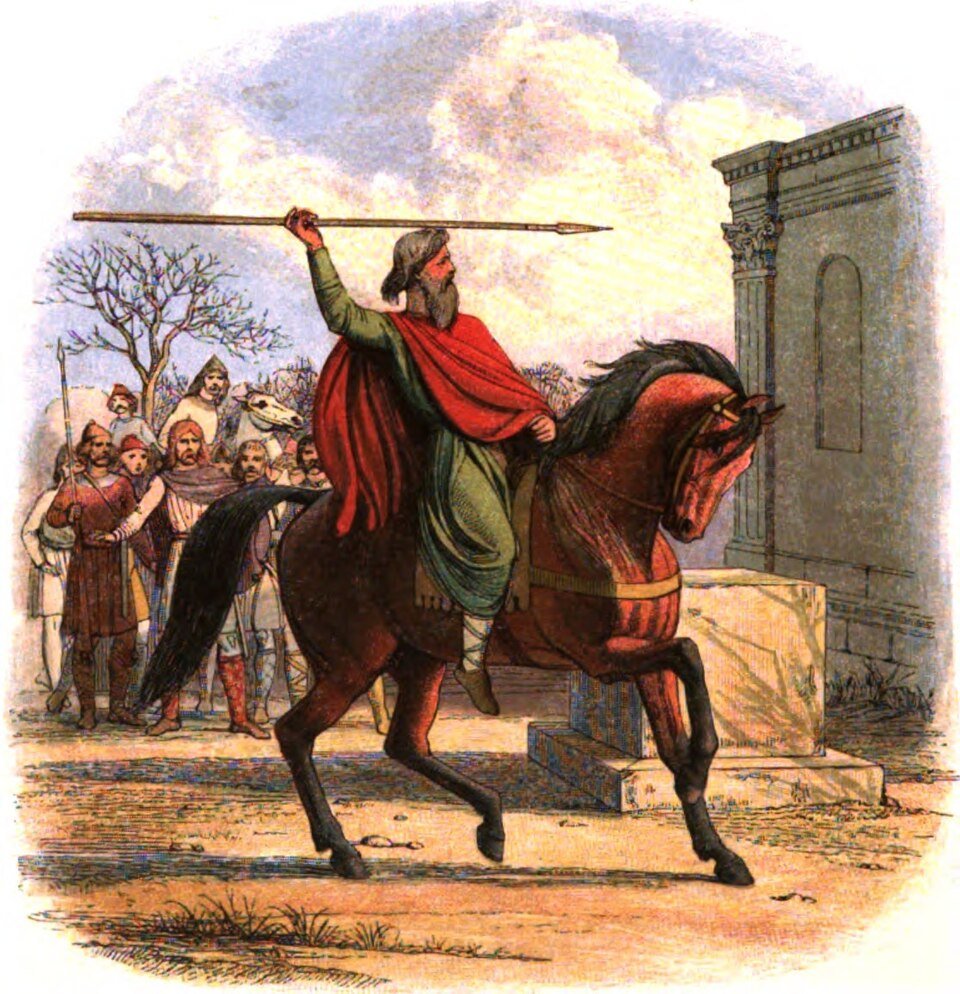
Bede’s description of this moment is vivid. Coifi rides to the temple, casts a spear into it, and orders its destruction by fire. This dramatic gesture symbolises the complete rejection of the old religion.
As Barrow has suggested, the imagery here may be deliberate. The act of piercing the temple recalls the Roman soldier who pierced Christ’s side during the crucifixion. In this interpretation, the temple becomes a symbolic body, and its destruction mirrors the transformation brought about through Christ.³
More broadly, the destruction of the temple represents the wider consequences of Edwin’s conversion. The king’s acceptance of Christianity signals the decline of paganism within his kingdom.
Conclusion
Bede’s emphasis on Edwin’s consultation with his advisors serves to reinforce his portrayal of the king as wise and deliberate. At the same time, the figure of Coifi plays a crucial role in advancing Bede’s broader argument.
Whether Coifi was a historical individual or a constructed figure, his purpose within the narrative is clear. He embodies the perceived failure of paganism and highlights the superiority of Christianity. Through him, Bede is able to present conversion not only as a personal choice but as an inevitable and necessary transformation.
In this way, the episode illustrates both the political realities of conversion and the narrative strategies employed by Bede to promote the Christian faith.
Footnotes
- J. Barrow, ‘How Coifi Pierced Christ’s Side: A Re-Examination of Bede’s Ecclesiastical History, II, Chapter 13’, Journal of Ecclesiastical History, Vol. 64, No. 4 (2011), pp. 704–706.
- J. Barrow, ‘How Coifi Pierced Christ’s Side…’, pp. 704–705.
- J. Barrow, ‘How Coifi Pierced Christ’s Side…’, p. 703.