
In the second half of the fifth century, Gaul, encompassing modern-day France, was in tatters. The Roman state had largely collapsed north of the alps, leaving a patchwork of states throughout modern France. Some, like the rump state of Syagrius, used old Roman authority to bolster their rule. Others, newcomers, were out to create something new. The largest of these groups were the Franks, a Germanic-speaking group from northeast of the Rhine. They had initially come as soldiers for the Romans, foederati or allies, serving in their armies and regularly defended against other barbarians. However, as Roman power in Gaul receded, the Frankish kings began to instill their own authority over the populace. The Frankish royal family, known as the Merovingians, would proceed to rule Gaul for the next two and a half centuries, with the mark of their kingship remaining all the way up to the eve of the French Revolution.
The first of these kings was a warleader named Clovis. Over the course of his long reign, Clovis would defeat the other rivals of Gaul and bind the Roman aristocracy and church to him. Even by the standards of a war torn period, Clovis was a man of sudden and aggressive violence. But even as his rivals wrote of him as a scourge, the Merovingian king would establish himself as the founder of French dynasties, and the first in a long line of Louis’ that would hold the crown.
A Pagan People
In the mid-fifth century, Roman Gaul had become a battleground between these shifting powers. At the battle of the Catalaunian plains, the Romans under Aetius managed to hold off the Huns, but in the process found themselves unable to hold onto their Gaulish lands. Behind them, they left a Gaul with no clear central leadership. There was a small Roman rump state centered around modern Soissons, the Visigoths were centered around Toulouse in the south, and the Burgundians bordering the Italian alps. In the space in between, thousands of people migrated to Gaul. One of the largest migrations came from the Franks of the northeast.
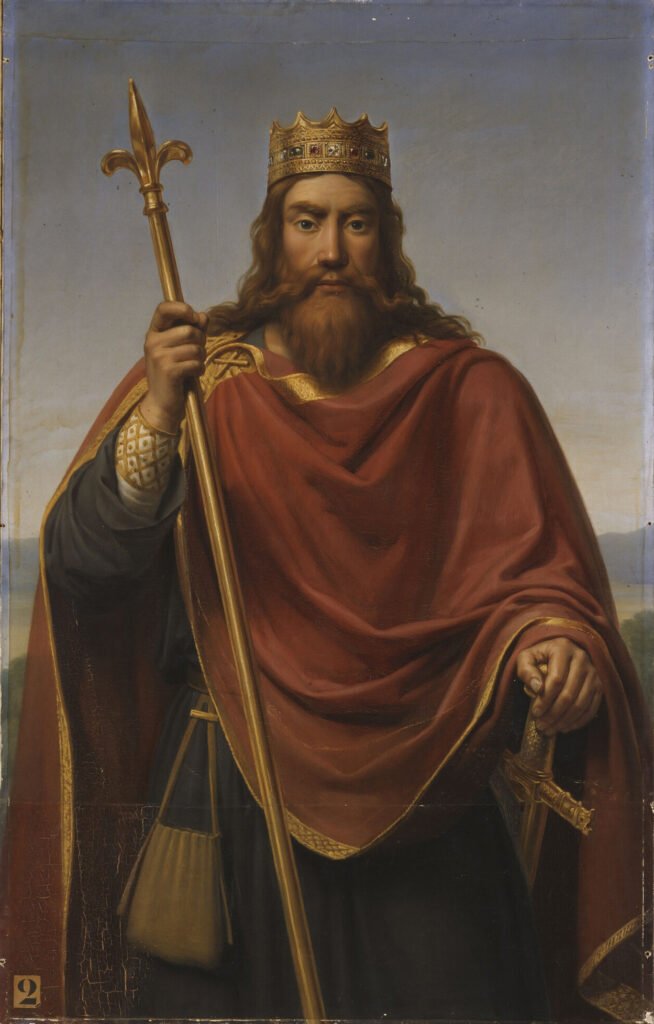
A painting depicting Clovis 1837. Wikimedia Commons
According to tradition, the Franks had been crossing the Rhine for generations, and by the mid to late fifth century, had coalesced into a state that bordered modern Belgium and modern France. According to later chroniclers like Gregory of Tours, the king of the Franks at this time was a warleader named Childeric. Little is known of Childeric, save that he was a talented warrior, and the petty king of a group of Franks known as the Salians. At this time, the Franks were a pagan people, though little is known about their religion. In the seventeenth century, a grave that seems to be designated to Childeric was dug up and categorised. In it, there are various grave goods with inscriptions, as well as signs of a sacrificed horse, a clear indication of Paganism in Frankish rituals.
The Man who would Bend Gaul to his Will
In 481 C.E., Clovis succeeded his father as king of the Salian Franks, a petty Frankish kingdom centred around Tournai in modern Belgium. At the time he was incredibly young, probably less than twenty years old. At the time, Clovis was only one petty warlord in a landscape full of men who would claim to be king. Post-Roman politics were never stable at the best of times; the land of northern Gaul was a veritable viper’s nest, and it would have been all too easy for a young man like Clovis to quickly be brought down by another warleader, or even his own men. Instead, the king of the Salian Franks found an enemy.
If northern Gaul had any coherent authority, it was the Roman rump state in Soissons. A generation before, the failing Imperial authority had given the military governorship of Gaul to Avitus, a Gallo-Roman aristocrat, who, in the absence of any higher authority, passed his rule onto his son, Syagrius. Syagrius claimed the rulership of Gaul, and imposed his will upon the Frankish and Breton tribes of northern Gaul. If Clovis were to be the ruler of these lands, he would have to defeat the last Roman.
Clovis forged an alliance with two other Frankish petty kings, and stormed Soissons in 486 C.E. Despite the betrayal of one of his allies, Clovis thundered through the Roman rump state, taking northern Gaul for his own, and sending Syagrius fleeing to the court of the Visigoths. In a stroke, the king of the Salian Franks had become master of Northern Gaul.
In fact, the largest challenge to Clovis’ initial foray was not a warlord, but the Catholic church. The clergy of Gaul opposed the pagan lord, ordering their parishes to oppose his soldiers at every turn. In retaliation, Clovis burned his way through northern Gaul, making sure to sack each church he encountered. He took Verdun and Paris after long sieges, taking the riches of all he found. It was only when the bishop of Rheims demanded the return of their church’s wealth, that Clovis relented, founding several abbeys and returning the treasure of Rheims. Realising that he would need the Catholic Church to rule Gaul, he married a Catholic Burgundian woman, Clothilde, who would have a profound influence on him.
Enemies and Allies
Clovis quickly became the most formidable power in Gaul, and the other kingdoms began building their alliances. Burgundian pretenders used his marriage to leverage an alliance, even as the King of the Franks integrated Celtic Bretons and Gallo-Romans into his armies. The warlike king of the Franks found himself using diplomacy and soft power to consolidate his reign.
But the ruthless killer was never far from the surface. In one of his early Roman conquests, Clovis found a Roman style vase that the bishop of Rheims begged to have returned. The king of the Franks agreed, but he was no autocrat, and one of his men resented the charge. The warrior smashed the vase with his axe, demanding that none of them should have it. Clovis did not react, instead sending the shards of the vase to Bishop Remigius. However, as he consolidated his power, the King of the Franks could demand more loyalty from his men. One year later, Clovis took the axe of this warrior, throwing it to the ground. As the man went to pick it up, he killed him, yelling “Just as you did to my vase at Soissons!”
For all his brutality, Clovis was a patient man. When Syagrius escaped to the Visigothic court in Tolosa, the King of Franks set his eyes on that southern prize. But his lords were not behind him, and so he waited. He waited until his good relations with the Catholic Church did his work for him, and the Catholics of southern Gaul began to resent their Arian Gothic lords. And in 507, almost twenty years after his defeat of Syagrius, he invaded with his army of Franks, Romans and Bretons, crushing the Visigoths at Vouille, killing their king and sending them fleeing into Iberia. Clovis had won, and there were none who could challenge him.
A Most Saintly Man
Since his agreement with the Bishop of Rheims, Clovis had enjoyed positive relations with the Catholic Church. But according to Gregory of Tours, he always remained a pagan despite the active influence of Clothilde, his Catholic wife. However, as complete master of Gaul, he ruled over thousands if not millions of Gallo-Romans, Christian people who viewed their world through a Roman lens. It was not enough to simply be the strongest lord, he must also win legitimacy.
Throughout his long reign, Clovis maintained relationships with the church, working alongside the future Saint Remigius of Rheims. For a time, he considered converting to Arian Christianity, the faith of the Goths, and one more common among Germanic speaking peoples. However, Clothilde was a Catholic, and throughout their marriage she encouraged him to ally with the Catholic church. And in 508, after defeating the Goths in battle, he finally conceded.
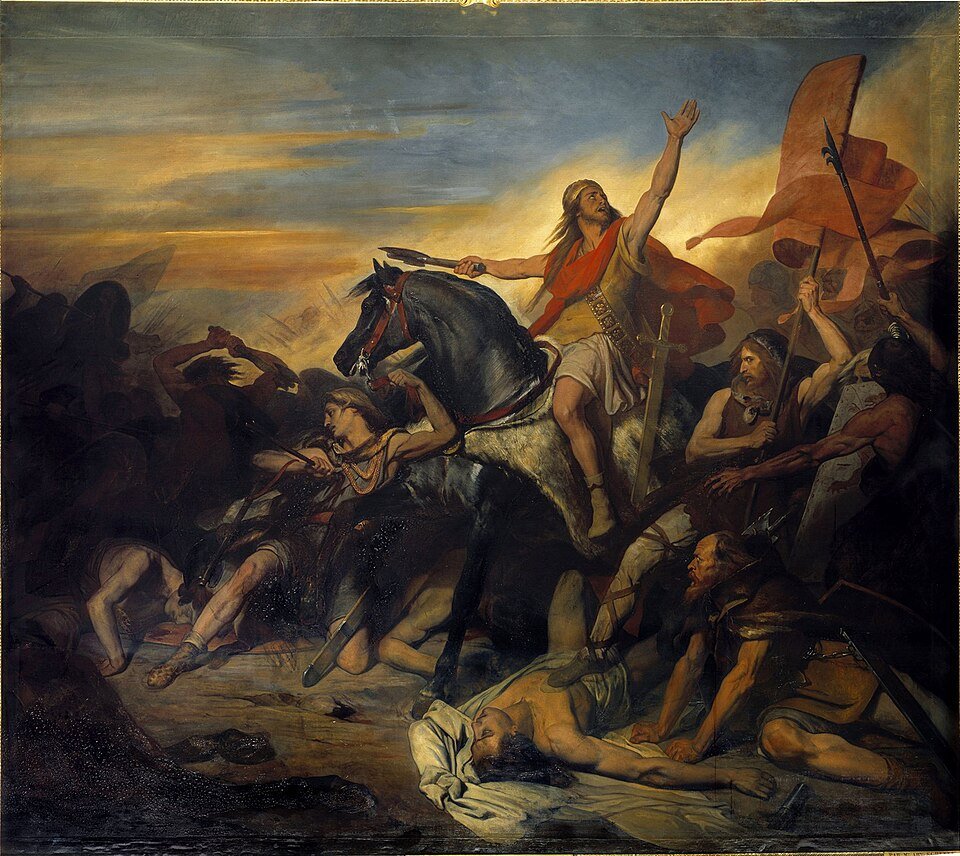
It is striking that Clovis’ most impactful moment did not come on the battlefield but rather at the baptismal font. Despite his many reservations, namely that his young son had died after being baptised in secret, Clovis agreed to convert at a small church outside of Rheims. Towards the end of his life, he also called a council of bishops and priests to make an accord between the Frankish kings and the Catholic church, which in turn led to stronger relationships between the Franks and the Romans they ruled.
Clovis may not have been a particularly devout catholic, but his conversion had a lasting effect on all of western Europe. He became the barbarian king that the Catholic Church would deal with, and put pressure on the other Germanic kings. The Frankish and later French kings would hold tight to this relationship, depicting themselves as the most Christian of kings. Clovis died in 511, and throughout most of history, he had been venerated as a saint in France. While hardly saintly in his manner, the first Frankish king of Gaul, through war and diplomacy by halves, built a legacy that lasted over a thousand years.
Bibliography
Gregory, Saint, Bishop of Tours, 538-594, Gregory, Saint, Bishop of Tours, 538-594, and Brehaut, Ernest, 1873-1953. History of the franks. New York :: Norton, Ann Arbor, Michigan: MPublishing, University of Michigan Library, 1969.
Wood, Ian. The Merovingian kingdoms: 450-751. Longman, 1997.


2 comments
The beginning of a new history for Western Europe. Great article!!!
[…] and Neustria, centred around modern Paris in France. Frequently, the siblings and descendants of Clovis would turn to civil war and violence, until it was rare that these different kingdoms would ever […]